In control systems engineering, a homeostatic controller has one function: maintain a target state by counteracting any perturbation. Your body uses this mechanism constantly. Core temperature deviates from 37°C, and the controller fires sweating or shivering to bring it back. Blood glucose rises, and insulin is released to restore equilibrium. The target state is defended automatically, regardless of the direction of the perturbation.
Your brain applies the same mechanism to subjective wellbeing.
A positive event (a salary doubling, a promotion, a marriage, a new car) produces a sharp increase in reported happiness. The controller detects the deviation from baseline. Over weeks to months, the hedonic adaptation process runs: familiarity increases, the novelty response diminishes, and the happiness level returns toward the pre-event baseline. The step input has been cancelled. The system is back at equilibrium.
This is not a failure of gratitude or discipline. It is the controller working exactly as designed. The control system that keeps you stable after trauma also keeps you from sustaining happiness after good fortune. The same mechanism. The same setpoint defense. Same direction, opposite context.
The Hedonic Treadmill is what happens when you try to fight this controller with more spending.
The Control System Model
The standard happiness control loop has three components:
-
The setpoint: Your baseline hedonic level, roughly constant, largely heritable, approximately stable over time. Kahneman’s research on SWB (subjective wellbeing) suggests this setpoint explains the majority of variance in long-run happiness, more than income, more than circumstances.
-
The sensor: Your brain’s continuous sampling of current hedonic state relative to the setpoint. Novelty amplifies perceived deviation from baseline; familiarity suppresses it.
-
The controller: Hedonic adaptation, the process by which the brain recalibrates expectations and emotional responses until the current state feels like the new normal.
The response to a positive input (new car, raise, promotion) follows a predictable waveform: a sharp transient rise in happiness, followed by an exponential decay back toward the setpoint. The decay timeconstant varies by event type, since sensory upgrades (cars, furniture, gadgets) adapt faster than social events (relationships, community), but the decay is consistent and documented across cultures.
The treadmill emerges when the consumer response to this decay is to increase the input signal to restore the peak. The $6 latte replaced the $2 coffee to generate the novelty response. When the $6 latte adapts, the response is to find the next upgrade. Each successive input must be larger to generate the same transient response, because the baseline has been recalibrated upward.
The Ratchet Asymmetry
The treadmill has a crucial asymmetry that the controller model captures precisely: the setpoint recalibrates upward after positive events, but downgrading inputs after adaptation does not return to the original baseline. It drops below it.
After you adapt to $6 lattes, switching back to $2 coffee does not feel like neutrality. It feels like deprivation. The sensory comparison is now between the current input ($2 coffee) and the adapted expectation ($6 latte standard), not between the current input and the pre-treadmill baseline.
This is the ratchet mechanism. Consumption floors rise monotonically. Each adaptation raises the minimum acceptable input level. You cannot run the process in reverse without experiencing a negative transient, a happiness response that goes below the original baseline before recovering.
The financial consequence is severe: once you have adapted to a consumption level, maintaining that level is the cost of returning to baseline. Exceeding it is the cost of a brief positive transient. And below it is below-baseline territory, not neutral but actively negative.
You are not buying happiness with the upgrade. You are buying back to where you started, temporarily. And you are permanently raising the cost of that starting point. The waveform below traces that cycle.
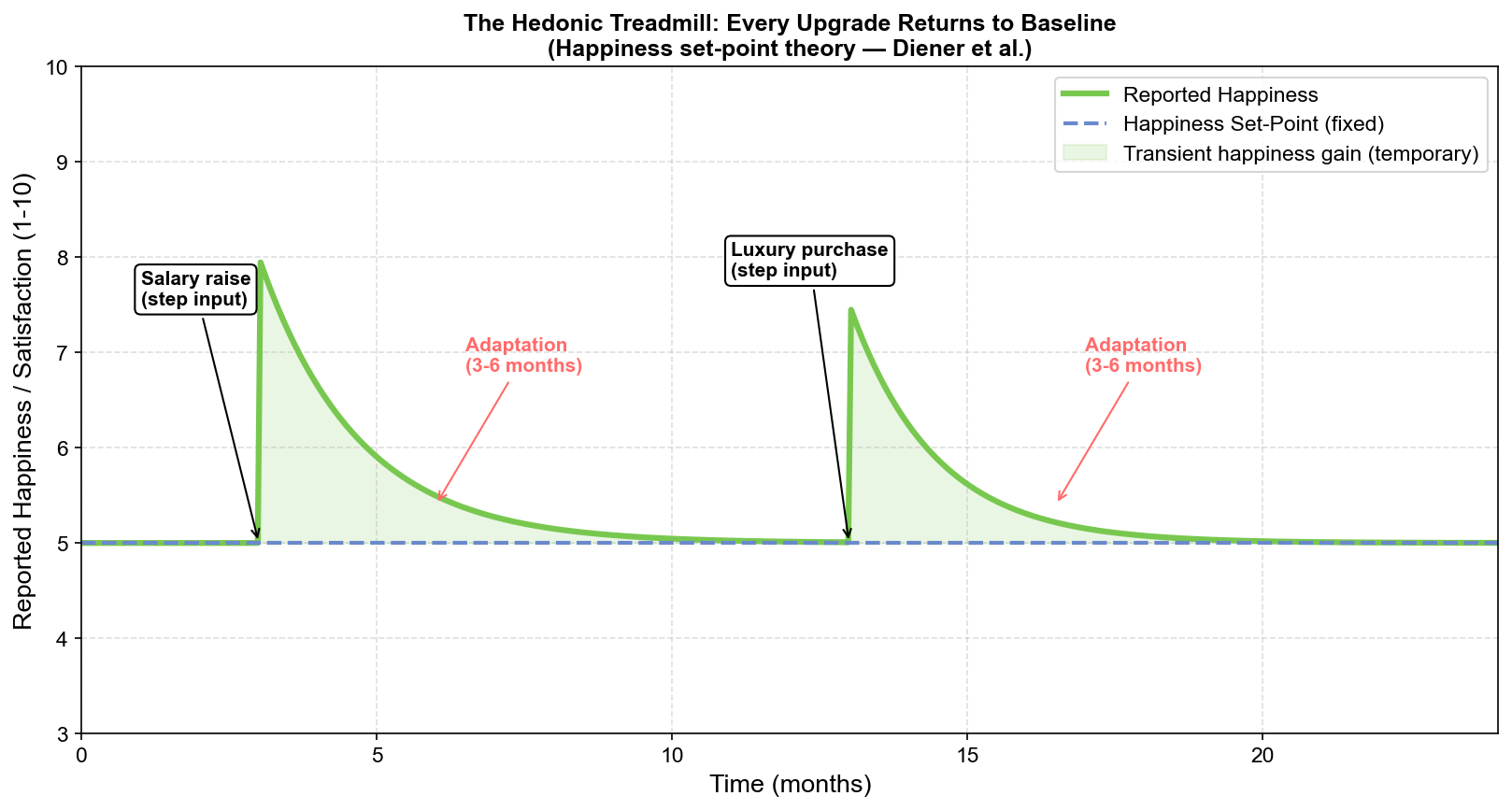
The chart shows the waveform clearly: each new stimulus generates a transient rise in satisfaction followed by decay. The adaptation level (the floor) rises with each cycle. The peaks stay roughly constant in amplitude but require progressively more expensive inputs to generate. The consumer is working harder and spending more to stay in place on the satisfaction curve.
The Three Things That Beat the Controller
The control systems framing identifies the logical ways to exit the loop:
Option 1: Reduce input frequency (delay adaptation)
Adaptation speed is directly related to exposure frequency. Daily access to a stimulus accelerates adaptation; periodic access slows it. The research on experiential consumption versus material consumption shows this clearly: experiences adapt more slowly than objects because they cannot be accessed continuously.
The practical implication: if you intend to purchase something, the version that provides periodic access adapts more slowly than the version that provides continuous access. A vacation adapts more slowly than a vacation home. A restaurant meal adapts more slowly than a meal-kit subscription. Spacing out the inputs extends the novelty response before the controller cancels it.
This is not asceticism. It is deliberate exposure management, using the mechanics of the adaptation process to extract more hedonic return from the same dollar.
Option 2: Switch to non-adapting inputs
Not all positive inputs adapt at the same rate. The research literature consistently shows that certain categories adapt slowly or incompletely:
- Social connection: Relationships, community, and belonging produce sustained wellbeing effects that resist adaptation. The novelty fades, but the baseline rises: the setpoint itself can shift upward through deep social integration.
- Autonomy: The ability to control how you spend your time produces wellbeing effects that are largely adaptation-resistant. Having the choice to work is categorically different from having the obligation to work, and this distinction does not fully adapt.
- Mastery: Progress toward meaningful skill development produces wellbeing that is self-reinforcing instead of self-cancelling. The signal does not decay; it evolves.
Material upgrades (vehicles, electronics, luxury goods) are in the high-adaptation category. Experiences and states (autonomy, relationships, mastery) are in the low-adaptation category. Allocation toward the second category generates sustained wellbeing per dollar at a rate that materially outperforms the first.
Option 3: Use negative contrast deliberately
The adaptation process runs in both directions: adaptation to scarcity or constraint also occurs, and breaking that adaptation with periodic access creates a strong positive signal. The cold shower that makes the warm shower feel better. The period of frugal travel that makes the occasional premium experience feel exceptional.
Deliberate constraint cycling, periodic voluntary reduction of stimulus level, resets the baseline downward, making the return to normal feel like an upgrade. This is not punishment. It is baseline management: ensuring the controller is calibrated to a level where normal feels good instead of to a level where normal feels insufficient.
What This Means for the FI Timeline
The Hedonic Treadmill has a direct effect on the Freedom Velocity Curve. The treadmill mechanism is what drives the coupling between income and expenses, the behavioral engine behind Parkinson’s Second Law (expenditures rise to meet income).
As income rises, the natural response of the adaptation-seeking brain is to increase inputs to generate novelty responses. The inputs are spending. The spending increase is the treadmill running. The result is that the savings rate stays flat or decreases despite rising income, which keeps your position on the Freedom Velocity Curve unchanged or moves it in the wrong direction.
This is why the formula shows that income cancels out. Not because income is unimportant, but because the adaptation controller automatically converts most income increases into equivalent spending increases, leaving the savings rate, and therefore the position on the curve, unchanged.
The engineer who understands the treadmill can override the controller. Instead of directing income increases toward the adaptation-seeking loop (material upgrades that generate brief positive transients and then require maintenance), they direct them toward the low-adaptation category (autonomy, optionality, time control, which the portfolio purchases). The savings rate rises. The position on the Freedom Velocity Curve moves left. The timeline compresses.
The Practical Protocol
Three things directly follow from the control systems model:
Audit your adaptation rate. For every major recurring expenditure, ask: am I still getting the happiness signal that justified this cost, or have I adapted and I am now paying to maintain a raised floor? Subscriptions, dining habits, vehicle upgrades, and housing premiums are the most common candidates for full adaptation with zero remaining positive signal.
Calculate the maintenance cost of your current setpoint. Sum up all the expenses that exist to maintain your adapted consumption level instead of generating genuine positive value. This is the hedonic maintenance cost: money going not toward any marginal happiness but toward preventing a below-baseline experience. This number, multiplied by 25, is the portfolio capital required to fund the treadmill indefinitely.
Redirect at least 50% of each income increase to savings before the treadmill can incorporate it. The adaptation process is not instantaneous. When income increases, the baseline does not rise immediately. The controller needs time to recalibrate. The window between the income increase and the full adaptation of expectations is the capture window. Every dollar redirected to savings during that window is extracted from the treadmill before it can be absorbed.
The hedonic controller cannot be disabled. But like any controller, it can be managed. The inputs it receives, the baseline it defends, and the categories it is fed are all variables. The treadmill runs on what you give it. Feed it correctly, and the controller that cancels your spending upgrades will leave your financial independence timeline intact.
This article is adapted from Chapter 3 of Debugging Your Personal Finance, which frames the Hedonic Treadmill alongside the Diderot Effect as the two behavioral algorithms that execute the zero-gap equilibrium. Chapter 2 introduces hedonic adaptation as the hardware mechanism; this chapter identifies the treadmill as the software loop running on top of it, and the specific inputs that are adaptation-resistant enough to be worth funding.
🧮Interactive tool: Hedonic Ratchet / 50%-of-Raise CheckOpen →