In 1765, Denis Diderot, the French philosopher and encyclopedist, received a beautiful scarlet robe as a gift. He was not a wealthy man. He lived modestly, surrounded by modest things. But the robe was magnificent.
And then something happened that Diderot himself documented with unusual clarity: the robe made everything else in his apartment look wrong. His old desk was ragged by comparison. He replaced the desk. Then the rug looked cheap, so he replaced that. Then the chairs. The shelves. The curtains. By the end, Diderot had replaced every piece of furniture in his home, ended up in debt, and wrote an essay, “Regrets on Parting with My Old Dressing Gown,” that stands as one of the most precise first-person accounts of a phenomenon that behavioral economists would not formally name for another two centuries.
The Diderot Effect: a new purchase creates a perceived inconsistency with the existing environment, triggering a cascade of additional purchases to restore coherence.
For engineers, there is a more precise name for what happened to Diderot: a Breaking Change.
The Software Analogy Is Not a Metaphor
In software, a Breaking Change is a modification to a dependency that is incompatible with the existing system. When you upgrade a single library to a new major version, you may trigger a cascade of downstream incompatibilities. Every module that depended on the old interface must be updated. A single change propagates through the dependency tree.
Lifestyle has the same architecture.
Your current consumption stack is a coherent system: a set of components that are mutually consistent in quality, price point, and status signal. Every item in the stack is, in effect, at the same version. The G-Shock watch is compatible with the IKEA furniture, the Honda Civic, and the hoodie. None of them creates a perceived inconsistency with any other. The system is stable.
When you introduce a single component from a higher-version stack (say, a Rolex), you have created an incompatibility. The Rolex sends a status signal at a different amplitude than every other component in the system. The hoodie now looks wrong next to the watch. The Honda Civic looks wrong next to the watch. The apartment looks wrong next to the watch. To resolve the incompatibility, the system needs to be refactored to match the new version level.
This is not a psychological quirk. It is an engineering-predictable consequence of introducing a version-incompatible component into a coherent system.
The Two Lifestyle Stacks
The practical implication is that there are essentially two coherent operating states for a consumer lifestyle, and the transition between them is expensive in both directions.
Stack A (the stable, low-cost state):
- Vehicle: Toyota Corolla / Honda Civic / paid-off compact
- Watch: Casio G-Shock or equivalent
- Furniture: IKEA / West Elm entry-level / secondhand
- Wardrobe: functional, brand-agnostic
- Living situation: practical over prestigious
Stack A is internally consistent. Each component is compatible with every other. Total annual cost of ownership: low. Annual maintenance burden: low. Fragility score: low. The system runs stably and requires minimal attention.
Stack B (the premium, high-cost state):
- Vehicle: BMW, Mercedes, Porsche, or equivalent
- Watch: Rolex, Omega, or equivalent
- Furniture: Restoration Hardware, custom, designer
- Wardrobe: tailored, brand-conscious, seasonally updated
- Living situation: premium neighborhood, premium finishes
Stack B is also internally consistent. Each component is compatible with every other. Total annual cost of ownership: high. Annual maintenance burden: high. Fragility score: high. The system runs stably but requires significant and continuous income to sustain.
The danger is not in choosing Stack B deliberately. The danger is in making a single departure purchase: one item from Stack B while living in Stack A. That purchase is the Diderot robe. It introduces a Breaking Change.
The figure below traces that cascade step by step.
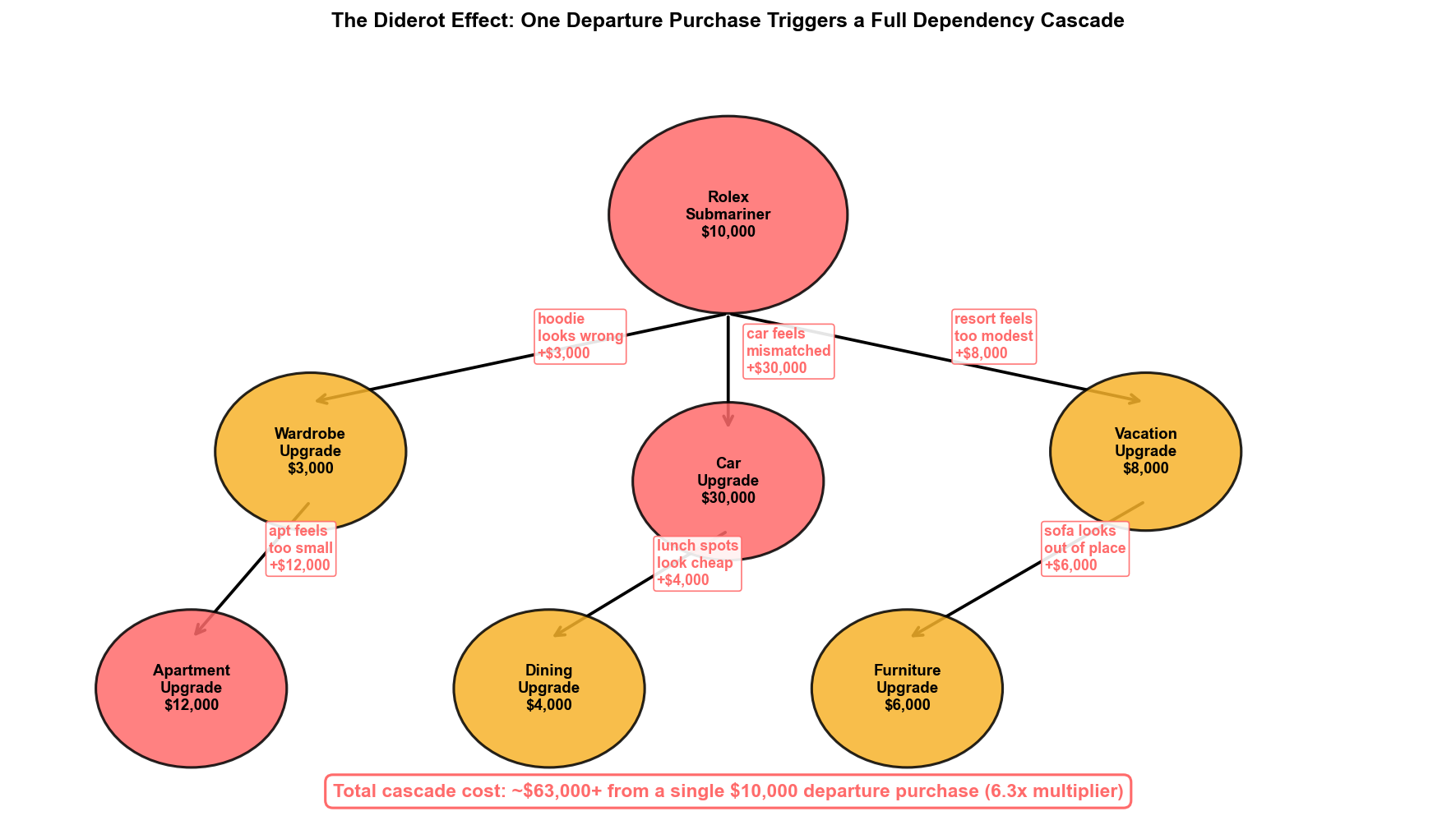
The visualization makes the cascade legible: a single departure purchase (the Rolex, the BMW, the premium apartment) launches a dependency chain. Each resolution introduces a new incompatibility. The cascade terminates only when the entire stack has migrated to the new version, at which point annual costs have increased by a multiple, not a margin.
The Financial Damage Is Nonlinear
The damage from a departure purchase is not equal to the cost of the departure item. It is equal to the cost of the entire stack migration that the departure item triggers.
A $10,000 watch does not cost $10,000. It costs $10,000 plus:
- The wardrobe upgrade required to be consistent with the watch’s status level
- The vehicle upgrade required (a Rolex on the wrist of a Corolla driver creates tension that many people cannot sustain)
- The home upgrade required (a Rolex owner living in a modest apartment experiences ongoing inconsistency pressure)
- The dining, social, and vacation escalations that follow entry into the social circles where the watch is appropriate
The stack migration is not completed in one transaction. It unfolds over months or years as each incompatibility is resolved and the resolution exposes the next one. The full financial impact is therefore invisible at the point of purchase. The $10,000 watch purchase is not framed as “I am committing to migrate my entire lifestyle stack to a higher cost tier.” It is framed as “I earned this, I can afford this one thing.”
Both framings are common. Only the second one is honest about what was actually purchased.
The Compatibility Test
The engineering fix for Breaking Changes is compatibility testing before deployment. Before introducing any new component into a production system, you verify that it is compatible with the existing dependencies. If it is not, you either refactor the system or choose a compatible component.
The same protocol applies to consumption decisions.
Before any major purchase, run the compatibility test:
-
Identify the version level of the item. What stack does this item belong to? What does it signal about the environment it is compatible with?
-
Check the existing stack version. Is the current system at the same version level as the item being introduced?
-
If incompatible, model the cascade. What are the downstream components that will experience inconsistency pressure once this item is introduced? What is the total cost of resolving those incompatibilities?
-
Decide based on full cost, not item cost. The decision is not “can I afford this item?” It is “can I afford, and do I want to fund, the stack migration this item initiates?”
For most departure purchases, step 3 reveals that the full cascade cost is three to ten times the cost of the departure item itself. For a $10,000 watch, the full migration may cost $50,000 to $150,000 in cascading upgrades over a two-to-three year window. The question is whether a system-wide upgrade to Stack B is desirable, not whether the watch is affordable.
The Coherence Premium
There is a legitimate case for choosing Stack B deliberately and completely. If the components of Stack B provide genuine utility (if the BMW is genuinely used to its performance limits, if the Rolex is genuinely appreciated for its craft, if the premium apartment adds demonstrable life quality) and if the stack is funded from income surplus above the required savings rate, the choice is defensible.
The problem is not Stack B. The problem is incoherence: paying Stack B prices for Stack A utility.
Most status purchases provide their maximum utility as signals, as markers of achieved status visible to others. The utility is not in the object itself but in the communication the object enables. If that signal is not providing a measurable return (career advancement, relationship quality, genuine satisfaction), it is pure cost with no return.
The coherence premium is the amount you are paying, per year, to maintain the signal-level of a stack your underlying life does not require. It is the annual cost difference between Stack B and Stack A, sustained indefinitely, for a return denominated in status, not experience.
Most engineers, when forced to calculate the coherence premium explicitly, find it surprisingly large and surprisingly indefensible.
The Stack Migration That Runs in Reverse
There is a second, underappreciated implication of the Diderot Effect: the same cascade runs in reverse when downgrading is considered.
Once you have migrated to Stack B, returning to Stack A is not simply a matter of selling the watch and buying a Corolla. The entire environment (the neighborhood, the social circle, the self-image) is now calibrated to Stack B’s level. Downgrading a single component creates the same inconsistency pressure that triggered the original cascade, but in the opposite direction: now the downgraded component looks wrong next to the rest of the system.
This is the ratchet mechanism that makes high-consumption lifestyles structurally sticky. You do not just need the income to afford Stack B in the present. You need it continuously, because the social and psychological infrastructure of Stack B makes reversion feel like loss, not choice.
The asymmetry (easy to migrate up, costly to migrate down) is precisely what makes the departure purchase so financially dangerous. You are not making a single purchase. You are committing to an ongoing, difficult-to-reverse migration that will consume a fraction of every future dollar you earn.
The engineering rule that prevents this: never introduce a component into production that you cannot roll back. For lifestyle stack decisions, “cannot roll back” is defined not by technical impossibility but by social and psychological cost. Departure purchases from a significantly higher stack version fail this test. They should be treated not as individual purchase decisions but as infrastructure migration proposals, reviewed against total migration cost, not unit cost, before deployment.
This article is adapted from Chapter 3 of Debugging Your Personal Finance, which frames the Diderot Effect alongside the Hedonic Treadmill as the two primary behavioral algorithms responsible for the zero-gap equilibrium that keeps income and expenses coupled. Chapter 2 extends the compatibility test into the Freedom Cost Matrix: a universal tool for pricing lifestyle upgrades in years of mandatory employment instead of dollars.