There is a number most engineers have never calculated, and it is one of the most important numbers in their financial life. It is not their net worth, their savings rate, or their effective tax rate. It is their commute cost, not the gas bill, but the full economic cost of their daily transit: cash expenditure plus time value plus foregone compounding.
For a typical engineer in a high-cost metro area, this number runs to $23,250 per year.
That is not an estimate pulled from a personal finance blog. It is a derivation from three inputs you can verify yourself: your salary, your commute distance, and the IRS mileage rate. The arithmetic takes five minutes. The implications take longer to process.
Part 1: The Cash Cost
Start with the numbers you can see on a receipt.
Assume an engineer earning $150,000 in a high-tax hub (California, New York, Washington) commuting 15 miles each way, five days a week. That is 30 miles round-trip, roughly 250 working days per year, producing 7,500 annual miles of commute distance.
The IRS standard mileage rate for 2025 is approximately $0.70 per mile. This rate is not arbitrary. It is a government-audited composite of fuel, vehicle depreciation, insurance, maintenance, and tyre wear. It is the most conservative, most defensible figure available for the per-mile cost of operating a personal vehicle.
Cash Commute Cost = 7,500 miles × $0.70/mile = $5,250/yearThat $5,250 is paid with after-tax dollars. At a combined federal and state marginal rate of roughly 35% for a California engineer at this income level, generating $5,250 in net take-home requires earning approximately $8,077 in gross income. You are working just under three full weeks in January (before doing a single hour of productive work) purely to fund the cost of getting to the office.
This is the visible commute cost. Most people have a rough sense of it. What almost nobody calculates is what comes next.
Part 2: The Time Cost
Time has an economic value. For an employed engineer, that value is measurable: it is the rate at which the market compensates them for each hour of focused work.
At $150,000 gross salary, the standard approximation is $72 per hour (salary divided by 2,080 working hours in a year). This is not a perfect measure (it ignores benefits, equity, and the non-linear value of deep work versus shallow time) but it is a reasonable floor for the opportunity cost of an hour.
Now count the hours.
A 30-minute each-way commute in moderate traffic is 1 hour per day. In a dense metro with realistic congestion, it trends toward 45 minutes each way, 90 minutes per day. Use the conservative figure: 60 minutes daily, 250 working days per year.
Annual Commute Hours = 60 min/day × 250 days / 60 = 250 hours/yearThese are not passive hours. They are not hours during which you can think deeply, exercise, read, or invest in relationships. They are hours trapped in a metal box in traffic, performing a task that produces zero economic, creative, or personal output. They are dead hours, not in the sense of rest, which is productive, but in the engineering sense of wasted cycles: processor time consumed by overhead instead of computation.
Time Value Cost = 250 hours × $72/hour = $18,000/yearThe Full Freedom Tax
Add the two components:
Freedom Tax = Cash Cost + Time Value Cost
           = $5,250 + $18,000
           = $23,250 per year
This is the annual levy your commute extracts from your financial independence timeline. It is not a tax in the sense of a government deduction. It is a structural drain on two separate accounts simultaneously: your cash account and your time account.
The cash drain is partially visible (you see fuel receipts and insurance bills). The time drain is entirely invisible. It does not appear on any financial statement, any pay stub, or any budget spreadsheet. It is simply gone, recurring, every working day, without a line item.
The chart below shows both components in context.
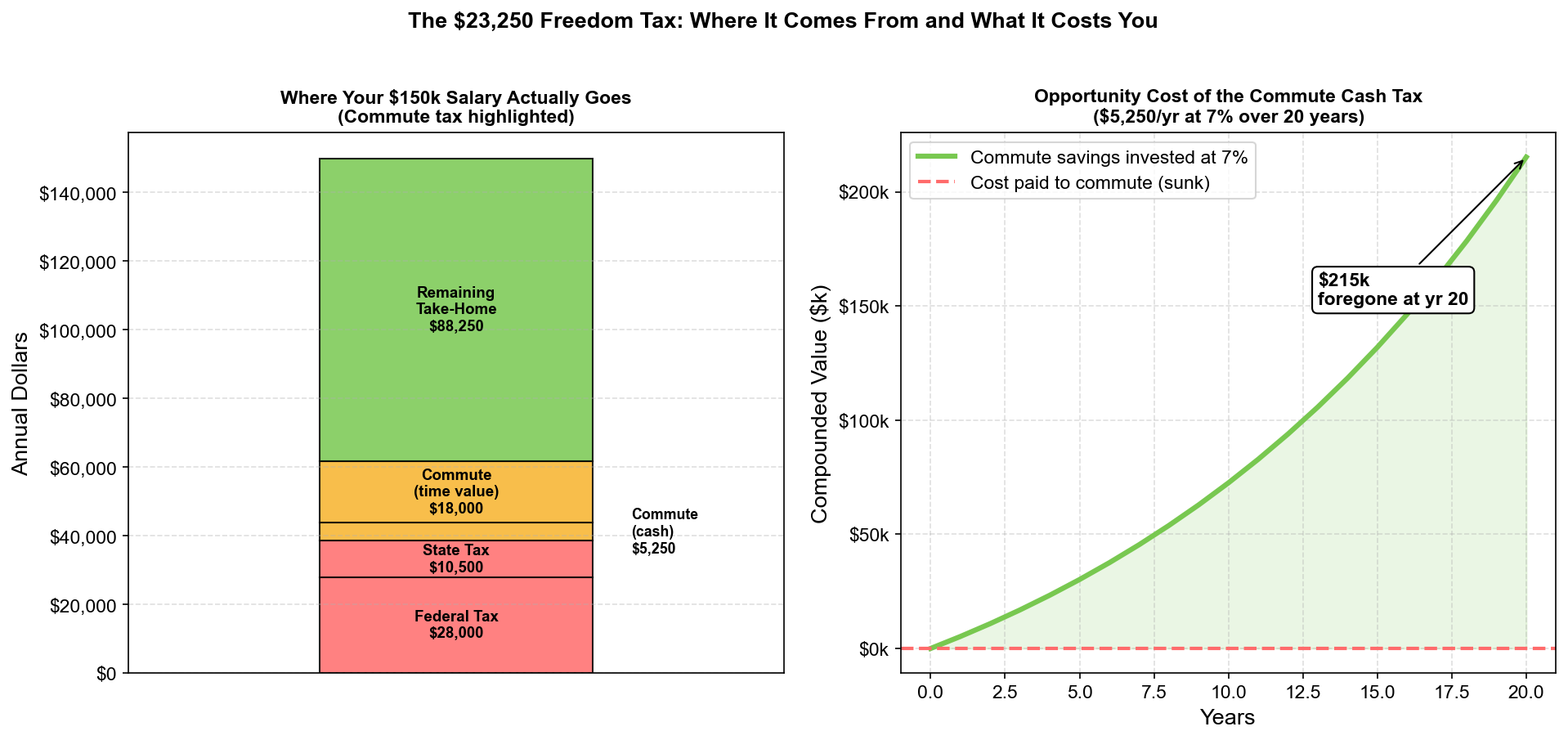
The left panel breaks down where a $150,000 gross salary actually goes before reaching discretionary spending. The right panel shows what the cash portion of the commute tax would compound to if invested instead, a figure that grows to over $220,000 over 20 years at 7% real return.
The Opportunity Cost: What the Tax Is Actually Buying
The $23,250 annual figure is the cost in present-year dollars. The real cost is what that capital would have compounded to if deployed into the market instead.
Consider just the cash component, the $5,250 per year that could be redirected to an index fund if the commute were eliminated. At 7% real return:
- 10 years: $72,500
- 20 years: $228,000
- 30 years: $528,000
That is the compounded opportunity cost of the cash tax alone. The time cost ($18,000 per year) is non-recoverable by definition, since time cannot be reinvested. But the cash cost can be redirected, and the trajectory of that redirection is material.
A 30-year career with a $5,250/year cash commute tax, compounded at the rate those dollars would have earned in the market, represents over half a million dollars in foregone wealth. Not because the commute was extravagant (15 miles each way is thoroughly ordinary) but because the cost was never calculated, never categorized as a tax, and never treated as a decision variable.
The Real Hourly Rate Adjustment
The commute cost also corrupts the standard hourly rate calculation that most engineers use.
The $72/hour figure is based on 2,080 billed hours per year. But the commute adds 250 hours of overhead to each working year, hours that must be spent to access the 2,080 productive ones. The true denominator is 2,330 hours, not 2,080.
Adjusted Hourly Rate = $150,000 / 2,330 hours = $64.38/hourThis is not a trivial difference. Your real hourly rate, the rate at which the market is compensating you for the totality of hours your employment requires, is $64, not $72. The commute costs more than time. It quietly reduces the effective return on every hour you work, because those hours exist within a larger overhead structure that the headline salary does not account for.
The fully-loaded commute cost, applied to the real hourly rate, is even higher than the $23,250 figure. But the conservative calculation is sufficient to make the point: the commute is not free, it is not cheap, and most engineers have never run this calculation.
The Remote Work Arbitrage
The financial case for remote work is not about comfort or work-life balance. It is an arbitrage calculation.
A remote engineer eliminates the commute tax entirely. The $5,250 cash cost disappears from the expense side. The 250 hours per year are returned to productive or personal use. The $23,250 annual drain stops.
The arbitrage is not symmetric. A remote role that pays $10,000 less than an in-office role but eliminates a $23,250 commute tax is a $13,250 net improvement to the financial independence timeline, before accounting for the compounding trajectory of the redirected cash.
Remote Arbitrage = Commute Tax Eliminated − Salary Reduction
                 = $23,250 − $10,000
                 = $13,250/year net improvement
Applied to the Rule of 25: $13,250 per year of improved net savings position reduces your required portfolio by $13,250 × 25 = $331,250, which at a $20,000 annual savings rate represents approximately 11 years of mandatory working life eliminated.
A $10,000 salary cut to go remote is, in many cases, the best financial decision available to a commuting engineer. The headline number moves in the wrong direction; the full calculation moves decisively in the right one.
Run Your Own Calculation
The formula is straightforward:
Freedom Tax = (Annual Miles × IRS Rate) + (Commute Hours × Real Hourly Rate)

where:
  Annual Miles     = round-trip miles × working days per year
  IRS Rate         = $0.70/mile (2025)
  Commute Hours    = daily round-trip minutes × working days / 60
  Real Hourly Rate = gross salary / 2,080
If your Freedom Tax exceeds $15,000 per year, you are funding a significant portion of someone else’s retirement with your own human capital, redirecting resources that could be compounding toward your financial independence into overhead that produces no return.
The commute is more than an annoyance. It is a measurable, computable, reducible tax on your freedom timeline. It has a dollar figure, a time figure, and a compounding trajectory. The engineers who treat it as an unexamined cost of employment will work years longer than the engineers who ran the calculation and treated it as a decision variable.
The calculation takes five minutes. The career implication spans decades.
This article is adapted from Chapter 2 of Debugging Your Personal Finance, which derives the full freedom tax framework alongside the Freedom Cost Matrix, translating every major lifestyle decision into years of mandatory working life. Chapter 10 builds this into a real-time financial dashboard where commute cost, savings rate, and trajectory are tracked as living metrics.