Two thousand years ago, Seneca wrote: “People are frugal in guarding their personal property; but as soon as it comes to squandering time they are most wasteful of the one thing in which it is right to be stingy.”
This is not a philosophical observation. It is a precise description of an asset misallocation problem, one that Seneca’s contemporaries replicated daily, and one that engineers in 2025 replicate with equal consistency. The specific details have changed. The underlying error has not.
The error is this: treating two fundamentally different asset classes as if they were interchangeable.
The Asset Class Comparison
Finance defines an asset class by its properties: how it is generated, whether it can be replaced, how it behaves over time, and what it can be exchanged for. Money and time appear superficially similar: both can be spent, both run out, both are tracked. But they differ in every property that matters for rational decision-making.
Money is a renewable resource. A depleted savings account can be replenished through labor. A lost dollar can be replaced by earning another one. Money is inflationary: a fixed sum erodes in real terms over time, which means the urgency to deploy it is limited by the rate of inflation and not by any absolute constraint. It is fungible: one dollar is identical to any other dollar. It is borrowable: you can pull future money into the present at a cost. And it is earnable: more can always be generated through additional labor or investment returns.
Time is a non-renewable resource. A depleted hour cannot be replenished under any circumstances. A lost day cannot be replaced by earning another one at any price. Time is fixed in supply: you have exactly as many hours as your lifespan provides, and the number decreases monotonically. It is non-fungible: an hour at age 30 is categorically different from an hour at age 65 in terms of health, energy, cognitive capacity, and available options. It is non-borrowable: you cannot pull future time into the present at any cost. And it is irreversible: once spent, it cannot be recovered, reinvested, or restored.
In any rational market, you trade the renewable for the non-renewable, not the reverse. If you had a renewable supply of water and a non-renewable supply of oxygen, you would guard the oxygen and use the water freely. The asset that can be regenerated is the medium of exchange. The asset that cannot be regenerated is the thing being protected.
Most engineers do the opposite. They guard money with extraordinary care (researching mortgage rates, comparing insurance premiums, optimizing tax-loss harvesting) while treating time as an abundant, low-value input. They accept 90-minute commutes, weekend projects, and soul-depleting roles without calculation. They are protecting the renewable asset and squandering the non-renewable one.
The True Price of Everything
Before reaching financial independence, every purchase is not made with money. It is made with time, with money as the intermediary.
The money is just the go-between. You work to earn it, and it converts into the things you own or the experiences you have. The actual trade is always: hours of your finite life in exchange for goods, services, or experiences. Money is the unit of denomination, not the underlying asset being spent.
This reframing changes the price of everything.
A $60,000 car purchased by an engineer whose real hourly rate is $30 per hour costs 2,000 hours of non-renewable life, not $60,000 of currency. Two thousand hours is 83 full days, or approximately five months of 40-hour working weeks. The question is not whether you can afford $60,000. The question is whether you are willing to trade five months of your finite life for that specific object.
A $4,000 vacation costs 133 hours at the same rate, about three and a half weeks of working time. The question is not whether the vacation is worth $4,000. The question is whether three and a half weeks of your life is well spent that way.
Most people find this reframe either clarifying or uncomfortable, depending on how they have been spending. The engineers who find it clarifying tend to make very different decisions from the ones who prefer not to think about it.
The Systemic Error Engineers Make
The asset-class confusion produces a specific, identifiable failure pattern in how engineers allocate effort and attention.
Engineers are trained to optimize. They apply optimization rigorously to problems where the cost function is clearly defined. Give an engineer a mortgage rate comparison, a tax-loss harvesting scenario, or a hardware cost analysis, and they will optimize it to the second decimal place. The cost function is denominated in money, which is visible, countable, and familiar.
But when the cost function is denominated in time, the same engineers frequently abandon the optimization framework entirely. They accept employment conditions that consume weekends without calculating the hourly rate of those lost hours. They take roles with brutal travel schedules without running the time cost against the salary premium. They optimize the money inputs to their financial system while leaving the time inputs entirely unmanaged.
Seneca described this in the first century AD. A Roman professional would spend hours negotiating a business contract to recover a few denarii, then accept a week-long journey that consumed far more economic value in lost time without a second thought. The denomination changed; the error is identical.
The corrective is methodological, not philosophical. Apply the same optimization discipline to time expenditure that you apply to financial expenditure. If you would not spend $5,000 without a clear expected return, do not spend 200 hours without a clear expected return. The assets are different in kind, but the optimization framework is the same.
The Freedom Point: Where the Trade Reverses
The entire financial architecture exists to reach a single inflection point: the moment when capital generates enough return to fund living expenses without requiring additional labor.
Before that point, every dollar spent is a trade of time for goods: the non-renewable for the renewable, running in the wrong direction. After that point, the portfolio generates income from invested capital: the renewable regenerates from its own returns, and time is no longer being sold to fund the renewable.
The chart below shows this dynamic across a working career:
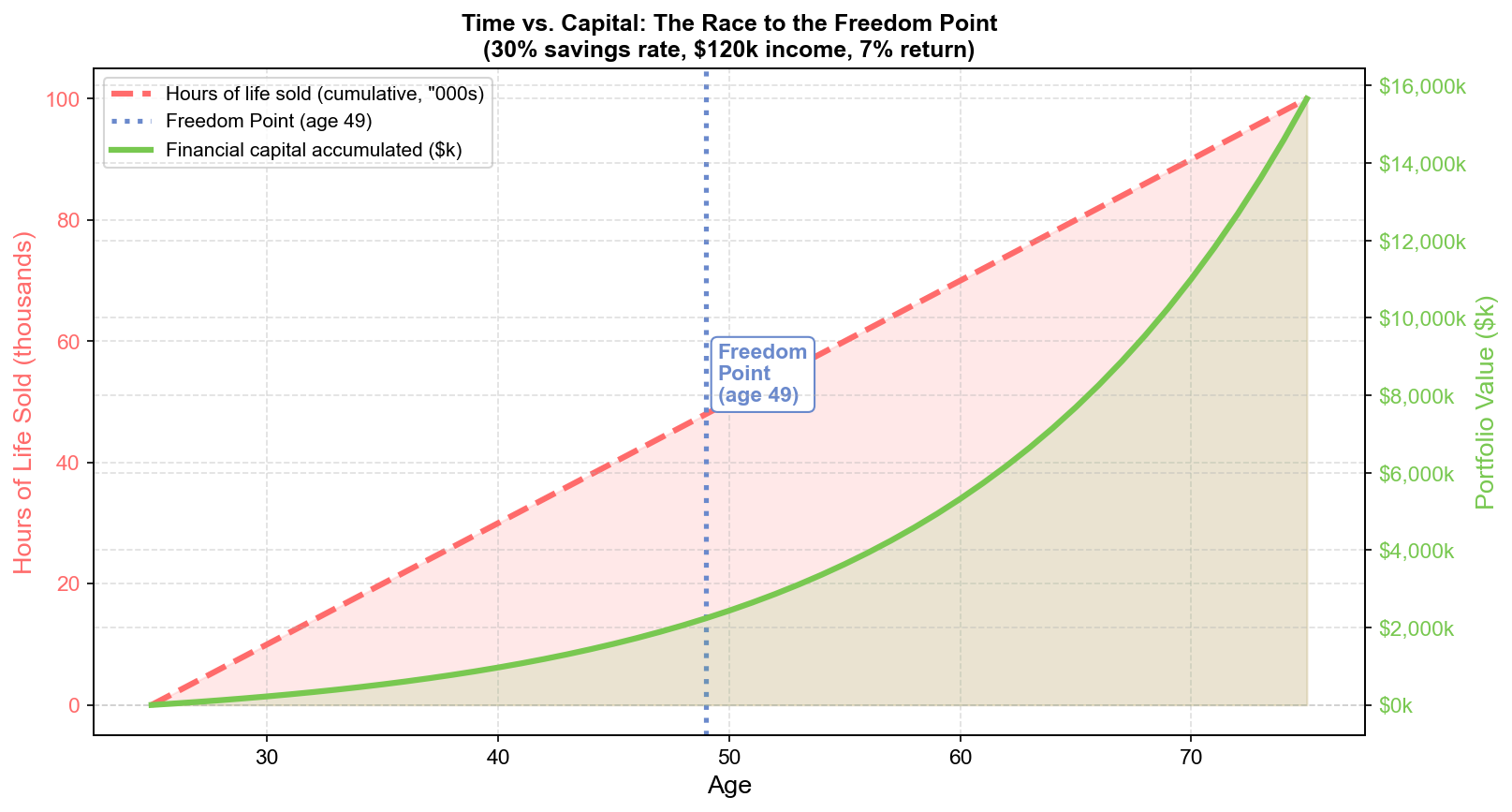
The left axis tracks cumulative hours of life sold for income, rising linearly as each working year adds its 2,000 hours. The right axis tracks the portfolio, rising exponentially as savings compound. The Freedom Point is the vertical line where the portfolio reaches 25× annual expenses: the moment when capital income can replace labor income.
Everything before the Freedom Point is the trade running in the wrong direction: time converted into money, money spent, time gone. Everything after it is the trade running in the right direction: capital generating income, time freed.
The entire framework of Debugging Your Personal Finance (the savings rate, the automation pipeline, the capital allocation waterfall, the monitoring dashboard) exists to pull the Freedom Point as early as possible. Not because work is inherently unpleasant, but because the ability to choose whether to work is categorically different from the obligation to work. That difference is the dividend of correctly managing the asset class of time.
The Practical Audit
Morgan Housel defines the terminal state of the time-money trade precisely: “The highest form of wealth is the ability to wake up every morning and say: I can do whatever I want today.”
This is not a description of a balance sheet figure. It is a description of an asset class position, one where the non-renewable asset (time) is fully under discretionary control, no longer being sold against its will to service fixed obligations.
The audit that makes this operational has one step: for every recurring commitment of time in your week, calculate its annual cost in hours and compare it against its return in income, growth, or genuine fulfillment.
Annual Time Cost = (Hours/week) × 52 × Remaining Career YearsA 90-minute daily commute over a 25-year remaining career represents 14,625 hours, approximately 1,827 full working days, or 7.3 years of 40-hour weeks. That is the non-renewable capital being committed to the commute choice, irrespective of its dollar cost.
A project that burns 10 extra hours per week for 5 years at a salary premium of $15,000/year: the time cost is 2,600 hours. At a $72/hour real rate, that is $187,200 of time sold for $75,000 of incremental income. The trade is negative.
The audit does not require that every commitment be profitable in a narrow financial sense. Some time expenditures, such as relationships, health, and creative work, have returns that do not denominate in dollars. But the audit requires that the expenditure be a conscious decision, not an unconsidered default.
Seneca’s engineers made time decisions by default. Modern engineers have the analytical tools to make them by design. The asset class is the same. The optimization framework is finally available.
This article is adapted from Chapter 2 of Debugging Your Personal Finance, which establishes time as the foundational asset class underlying the entire wealth-building framework. Chapter 8 extends this into a full human-capital model (treating career earnings as a depreciating asset that must be converted into financial capital before it runs dry) and identifies the Freedom Cross: the inflection point where passive income overtakes active income requirements.