“Compound interest” is having a moment in search, and the question underneath it is usually simpler than it sounds: is my savings account actually building wealth? The honest answer is that a savings account and a stock index fund run the exact same compounding machine — they just run it at very different rates, and the rate is the only input that matters over a long horizon.
Here is the whole argument in one picture. Two accounts, each fed the same $500 a month for 35 years. One earns about 1% real (a good high-yield savings account, after inflation). The other earns about 7% real (the long-run average of a diversified stock index, after inflation).
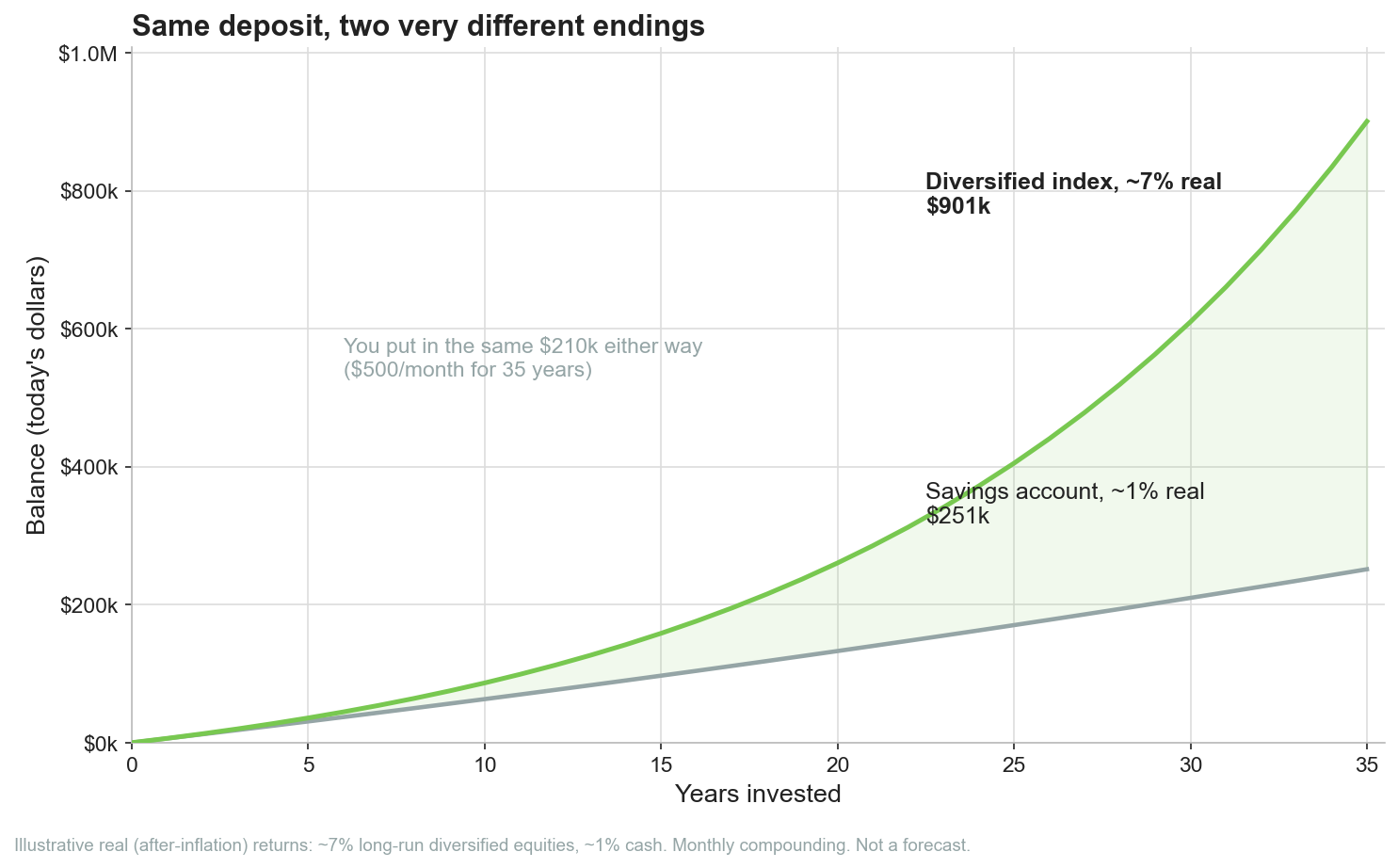
You deposited $210,000 into each ($500 × 12 × 35). The savings account returns it to you as $251k. The index turns it into $901k. The extra $650k was never money you earned at your job — it is compound interest, and it only materialized at the higher rate.
Why the rate lives in the exponent
Both accounts obey the same growth equation. For a stream of equal deposits, the future value is:
FV = PMT × [ ((1 + r)^n − 1) / r ]PMT is your deposit, n is the number of periods, and r is the rate per period. Notice where r sits: inside an exponent. Your contribution PMT enters linearly — double it and you double the result. The rate compounds. That asymmetry is the entire story.
At 1% the term in brackets grows almost in a straight line, because (1.01)^n barely curves. At 7% it bends upward, and every year the gap to the 1% line widens faster than the year before. The two curves start on top of each other — for the first five years the savings account is barely behind — and then the exponent takes over. Compound interest is not slow. It is back-loaded. Most of the $650k gap in the chart opens up in the final decade.
This is also why “I’ll start investing once I have more money” is the most expensive sentence in personal finance. The early deposits are the ones that get the most compounding periods, so they are worth the most. You are not waiting to invest a bigger number; you are throwing away the exponent’s best years.
What a savings account is actually for
None of this makes a high-yield savings account bad. It makes it a different tool. Cash has one job that stocks cannot do: be worth exactly what it says, on the day you need it.
- Emergency fund. Three to six months of expenses that must not be down 30% the week you lose your job.
- Near-term goals. A house down payment, a wedding, a tax bill — anything you will spend in the next roughly three to five years.
- Dry powder and liquidity. Money with a job to do soon.
For that money, the volatility of stocks is a bug, not a feature. A diversified index can and does fall 20–40% and take a few years to recover; if your time horizon is shorter than that recovery, you have converted a temporary paper loss into a permanent realized one. Cash exists precisely so you are never forced to sell stocks at the bottom.
The trap is using a savings account for money with a decades-long horizon — retirement being the obvious one. There, the volatility you were avoiding was never the real risk. The real risk was the quiet 6-percentage-point gap in the chart above.
The “safe” account has a hidden leak
The chart is in real (after-inflation) dollars on purpose, because the number a bank advertises is nominal. A 4% high-yield savings account sounds like it is keeping pace with a 7% index — until you subtract roughly 3% inflation and find its real return is about 1%. Inflation is a rate too, and it compounds against you in the same exponential way. A dollar left in “safe” cash for 35 years quietly loses most of its purchasing power; it just does it slowly enough that you never see a red number.
That is the resolution to the search-trend paradox. People typing “savings account vs investing” have usually just noticed that their balance goes up in dollars while it buys less each year. The account is compounding. It is simply compounding at a rate that barely clears the inflation it is fighting.
The rule this reduces to
Match the account to the time horizon of the money, not to how the market feels this week:
- Money you need within ~3–5 years → high-yield savings (or short-term bonds). Its job is to be there, in full, on the day.
- Money you will not touch for 10+ years → a broadly diversified, low-cost index fund. Its job is to catch the exponent.
- Everything in between → blend, tilting toward cash as the spending date gets closer.
A savings account is not a failed investment. It is a cash-management tool that you were never supposed to hold for 35 years. The compounding machine works in both accounts. The only decision you actually make is which rate you let it run at — and, as the chart shows, that decision is worth about $650,000.
The 7% and 1% figures are long-run real averages used to illustrate the mechanics, not a forecast; actual returns vary, stocks are volatile, and past performance does not guarantee future results. This is educational content, not financial advice.