A 1 percent fee sounds like a rounding error. Run it through one line of mental math and it turns a 7 percent return into a 6 percent return, which pushes your money’s doubling time from about 10 years to 12 and quietly deletes almost a third of a 40-year balance.
That one line of mental math is the Rule of 72. It is the most useful piece of arithmetic a saver can carry around, because it converts a percentage into a timeline you can feel. The rule says the number of years it takes an amount to double is approximately 72 divided by the percent rate of growth. At 8 percent, money doubles in about 9 years. At 4 percent, it takes about 18. You can do it at a dinner table without a calculator, and it is close enough that the error almost never changes a decision.
The rule is fun when you point it at your investments. It gets uncomfortable when you point it at the two places most people never think to aim it, which are the fees skimming your portfolio and the interest compounding on your debt. Before we go there, though, take a look at how the shortcut stacks up against the exact math, rate by rate.
Why the number is 72 and not 69
Doubling is a question about exponential growth, so the honest tool is the natural logarithm. If a balance grows at a continuously compounded rate r, the time to double is the natural log of 2 divided by r. The natural log of 2 is 0.6931. Multiply by 100 to work in percentage points and you get 69.31. So the mathematically clean rule would be the Rule of 69.31: years to double equals about 69.31 divided by the percent rate.
Nobody wants to divide by 69.31 in their head. This is where the choice of 72 comes from, and it is a choice about human arithmetic instead of a choice about mathematics. The number 72 sits close to 69.31, and it is far friendlier to divide by, because 72 has an unusual number of whole divisors: 1, 2, 3, 4, 6, 8, 9, 12, 18, 24, 36, and 72. That means 72 splits evenly by 2, 3, 4, 6, 8, 9, and 12, which are exactly the interest rates a normal person actually reasons about. Seventy-two over 6 is a clean 12. Seventy-two over 8 is a clean 9. Sixty-nine would give you 11.5 and 8.6, and you would stop doing the math.
There is a second reason 72 wins over 69.31, and it is a subtle one. Most real-world growth is compounded once a year, not continuously. Annual compounding is slightly slower than continuous compounding, so the true doubling time is a little longer than the pure log formula suggests. Nudging the numerator up from 69.31 toward 72 absorbs part of that gap for the mid-single-digit rates where savers spend most of their time. The rounding that makes the rule easy to compute also makes it slightly more accurate for the rates that matter most.
How close is the shortcut, really
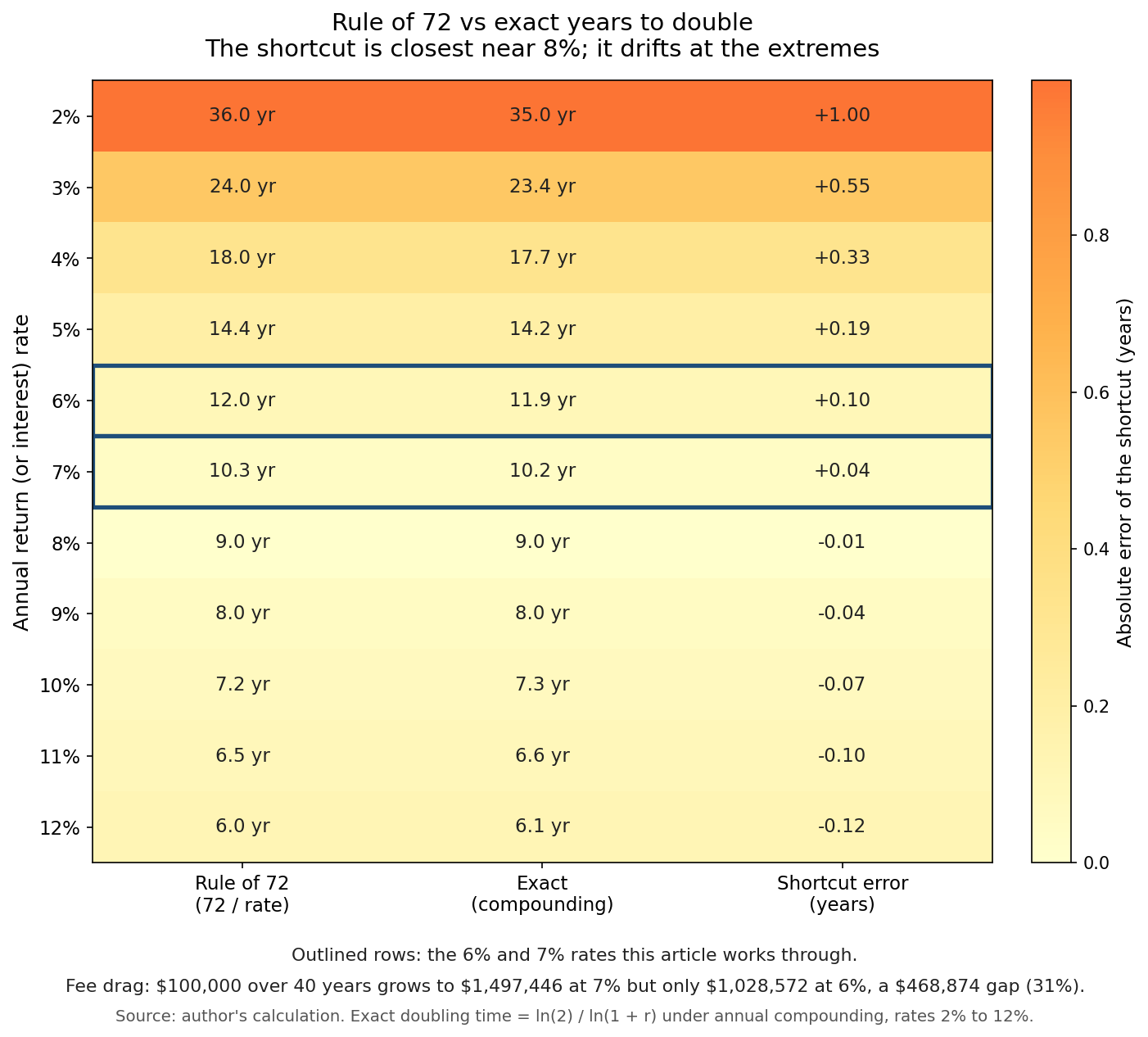
A shortcut is only useful if you know where it lies to you. The figure above lays the Rule of 72 next to the exact doubling time, computed from annual compounding, for every whole-percent rate from 2 percent to 12 percent. The left column is the shortcut, 72 divided by the rate. The middle column is the exact answer. The right column is the error in years, and the color of each row tracks how large that error is, so you can see at a glance where the rule is trustworthy and where it starts to drift.
Read down the grid and a pattern appears. The shortcut is most accurate around 8 percent, where it is off by about half a week. At 8 percent the rule says 9.00 years and the exact value is 9.01 years, an error of about one hundredth of a year. From that sweet spot the error grows in both directions, but it grows slowly. At 6 percent the rule gives 12.00 years against an exact 11.90, an overshoot of about 0.10 years. At 7 percent it gives 10.29 against 10.24, an overshoot of 0.04 years. At 10 percent it gives 7.20 against 7.27, now undershooting by 0.07 years.
The only place the rule visibly stumbles is at the low end. At 2 percent it predicts 36 years to double and the truth is 35, a full year off. At 3 percent it is off by about 0.55 years. For the entire range from 4 percent to 12 percent, which covers almost every serious conversation about stocks, bonds, savings accounts, and mortgages, the shortcut lands within about a third of a year of the exact answer. For a calculation you can do while pouring coffee, that is a remarkable trade.
The takeaway from the grid is that you should trust the Rule of 72 for planning and reach for the exact log formula only when you are pricing something at the extremes or when a small timing error compounds into real money. The next two sections are exactly those cases.
The fee version, where it stops being fun
Here is the move most people never make. Point the Rule of 72 at the fee instead of the return.
Suppose a broad stock portfolio earns 7 percent a year before costs. The Rule of 72 says your money doubles about every 10.3 years. Now suppose you hold that same portfolio inside a fund or an advisory arrangement that charges 1 percent a year. Your return is no longer 7 percent. It is 6 percent, because the fee comes out of the same compounding engine that grows your balance. The fee does not take 1 percent of your gains. It takes 1 percent of everything, every year, before the growth is measured.
Run the rule on both numbers. At 7 percent, doubling takes about 10.3 years. At 6 percent, doubling takes about 12 years. The 1 percent fee added roughly 1.7 years to every single doubling you were counting on. Over a long horizon your money doubles several times, and the fee taxes each of those doublings, so the gap does not stay small. It widens with every cycle.
The figure code computes the endpoint exactly so there is no hand-waving. Start with 100,000 dollars and let it compound for 40 years. At 7 percent it grows to 1,497,445.78 dollars. At 6 percent it grows to 1,028,571.79 dollars. The difference is 468,873.99 dollars. That single percentage point of annual fee consumed 31.31 percent of the balance you would otherwise have ended with. Nearly a third of the final pile, gone, in exchange for a number that looked like a rounding error on the statement.
This is the uncomfortable part of the rule, and it is why fee disclosures are written as small annual percentages instead of as lifetime dollar totals. One percent per year and “31 percent of your final wealth” are the same fact wearing two very different costumes. The annual framing feels survivable. The lifetime framing is the one that should drive the decision.
The point is not that every fee is a scandal. Some products earn their cost, and paying for genuine advice during a market panic can be worth far more than the fee. The point is that you should always convert the annual percentage into its lifetime toll before you agree to it, and the Rule of 72 is the fastest way to sense the scale before you reach for the exact number.
For context on how large these fees run in practice, Morningstar publishes an annual asset-weighted average expense ratio across U.S. funds, and in its long-running study that number has trended down over the past two decades into the low tenths of a percent as money has moved into low-cost index funds. Asset-weighted means it reflects the fees investors actually pay in aggregate, giving more weight to the funds where the most money sits, so it is a fairer gauge than a simple average of every fund on the shelf. The direction of that trend is the good news. The lesson of the 40-year arithmetic is why the trend matters so much: even fractions of a percent, compounded across a working life, move real six-figure sums.
The debt version, which is the same math running against you
Compounding does not care which direction it points. The Rule of 72 that doubles your savings will double your debt just as reliably, and high-interest debt sits at rates that make the doubling uncomfortably fast.
Point the rule at a credit card. Card interest commonly runs around 22 percent, a level the Federal Reserve’s data on commercial bank credit card rates has reached in recent years. Seventy-two divided by 22 is about 3.3. A balance you never pay down doubles in a little over three years. The exact number, from the same log formula the figure uses, is about 3.49 years, so “about 3.3 years” is the fast mental estimate and just under three and a half years is the precise answer. Either way, an untouched 5,000 dollar balance becomes roughly 10,000 in the time it takes to change jobs once.
Set the two sides next to each other and the asymmetry is stark. Your index fund at 7 percent needs more than a decade to double your money. Your credit card at 22 percent needs about three years to double what you owe. Debt at 22 percent compounds more than three times as fast as a healthy stock portfolio. That is the entire reason personal finance keeps repeating the same advice about paying off high-interest debt before investing. It is not a moral position. It is the Rule of 72, run in both directions, showing that the debt clock spins faster than the investing clock.
The same lens reframes a mortgage or a car loan. A 6 percent auto loan doubles the amount you owe on any unpaid balance in about 12 years, which is why stretching a loan term is expensive even when the monthly payment looks comfortable. Any time you are handed a rate, positive or negative, the Rule of 72 tells you how long it takes that rate to double whatever it is attached to, and doubling is a length of time you can actually reason about.
Carry the rule, respect its edges
The Rule of 72 earns its place because it turns an abstract percentage into a concrete timeline in one division you can do in your head. The grid in the figure shows it stays within about a third of a year of the exact answer across the entire 4 to 12 percent band where most financial decisions live, and drifts to about a full year only down at 2 percent. That is precise enough to steer a plan and simple enough to use on the spot.
Where it matters is in the two applications people skip. Run it on a fee and a harmless-looking 1 percent reveals itself as 468,873.99 dollars and 31.31 percent of a 40-year balance. Run it on a 22 percent card and the doubling time collapses to about 3.3 years, faster than three times the pace of a 7 percent portfolio. The arithmetic is the same in every case. The only variable is which direction the compounding is aimed, and the Rule of 72 is how you find out before the math finds you.