In robotics and control systems, a root constraint is a kernel-level directive that overrides every sub-process in the system. If a robot’s root constraint is “preserve human life,” no efficiency optimization, no path-planning algorithm, and no performance target can override it. The root constraint is not a preference or a guideline — it is the fundamental operating rule from which all other decisions are derived. Violate it and the system fails at the architectural level.
Most engineers run financial operating systems with a corrupted root constraint. Not a missing one — a corrupted one. The root constraint is there; it just points at the wrong objective. It is set to income maximization, or status optimization, or comfort preservation. And because it is a root constraint, every financial decision the system makes flows logically from it — optimizing for the wrong thing, consistently and at scale, for decades.
The fix is not a patch. It is a kernel rewrite.
The Three Corrupted Constraints
Understanding why the rewrite is necessary requires diagnosing which constraint is currently running. Most engineers fall into one of three failure modes.
Income maximization is the most common. The engineer optimizes every career decision for highest total compensation — chasing the role with the best salary, accepting the equity package that requires staying four more years, tolerating the brutal commute because the FAANG offer is worth it. The metric being maximized is throughput: dollars in per year. The flaw is that income maximization optimizes for the input to the system, not the output. Income that is entirely consumed by expenses and lifestyle inflation produces zero financial independence regardless of its magnitude. A $400,000 salary supporting a $380,000 annual spending rate is one layoff away from catastrophe. The system is highly loaded and completely fragile. Throughput without retention is not a wealth-building system — it is a cash-flow treadmill.
Status optimization runs the second corrupted constraint. The engineer optimizes for signals — the house in the right zip code, the car with the right badge, the conference room presence that reads “senior.” As shown in the previous article, these signals are never received by their intended audience. The observer re-addresses the signal to themselves. The sender receives no credit. The capital is deployed into a zero-ROI transmission. Status optimization is not just inefficient — it is logically self-defeating. You cannot optimize for a signal that cannot be received.
Comfort preservation is the subtlest failure mode and the hardest to diagnose, because it masquerades as prudence. The engineer avoids short-term financial friction — the pain of declining lifestyle upgrades, the discomfort of a high savings rate, the awkwardness of not keeping up with peers — in exchange for a smooth, frictionless experience today. The problem is that comfort in the short term is purchased with mandatory work in the long term. Every dollar not saved today requires an additional $1.07 next year (at 7% return) to produce the same future wealth. Comfort has a compounding price tag that most people never calculate.
All three corrupted constraints share the same architectural flaw: they optimize for variables that have no deterministic path to financial freedom. Income is an input, not an output. Status signals are never received. Comfort is borrowed from the future at compound interest.
The Rewrite: Freedom as Root Constraint
The correct root constraint is simple to state and difficult to internalize:
Freedom = total control over your time.
Not a net worth number. Not a salary level. Not a specific retirement age. The ability to wake up on any given day and have full discretion over how that day is spent — no obligation to appear anywhere, no dependency on a paycheck, no fear that declining a project will trigger a financial crisis. That is the definition of freedom as a systems property, and it is the only root constraint that produces financial independence as a deterministic output.
When freedom is the root constraint, every financial decision collapses into a single logical gate:
if cost_of_purchase > value_of_freedom_time_gained:
    return False
else:
    allocate_capital()
This is not a metaphor. It is literally how decisions change once the root constraint is rewritten. The question is no longer “can I afford the monthly payment?” — that is an income-maximization frame. The question is not “will this impress my peers?” — that is a status-optimization frame. The question is: does this purchase increase or decrease my time-to-freedom?
The BMW 3 Series fails this gate. The $9,000 annual premium over a Toyota Corolla requires $225,000 in additional portfolio capital. At a $20,000 annual savings rate, that is 8.6 years of mandatory working life. The gate fires: cost > value_of_freedom. Return False.
A gym membership that maintains the health to work productively and generate income for another decade passes the gate. Therapy that eliminates decision fatigue and improves savings behavior passes the gate. A remote work negotiation that eliminates a $23,250 annual commute tax and redirects that capital into the accumulation system passes the gate.
The emotional processing layer is bypassed. The decision becomes deterministic. This is the engineering value of a correctly set root constraint — it converts what are otherwise difficult, emotionally loaded decisions into simple evaluations against a clear objective function.
Why Time Is the Only Logical Basis for the Root Constraint
The root constraint must be set to freedom because of a fundamental asymmetry in asset classes that most financial frameworks ignore.
Money is a renewable resource. It is inflationary — a fixed sum erodes in real terms over time. It is earnable — more can always be generated through labor or investment. It is borrowable — future money can be pulled forward at a cost. It is fungible — one dollar is identical to any other dollar.
Time is a non-renewable resource. It is fixed in supply — no amount of money can generate an additional hour. It is non-borrowable — you cannot pull future time forward at any price. It is non-fungible — an hour at age 30 is categorically different from an hour at age 60 in terms of health, energy, and optionality. And it is irreversible — once spent, it cannot be recovered under any conditions.
Seneca identified this asymmetry two thousand years ago: “People are frugal in guarding their personal property; but as soon as it comes to squandering time they are most wasteful of the one thing in which it is right to be stingy.”
He was describing an asset misallocation problem. The engineers he was observing — the Roman professionals of his era — guarded their money carefully while trading their time carelessly. The modern version is identical: we spend hours optimizing to save 0.5% on a mortgage rate while accepting a 90-minute daily commute without calculation. We guard the renewable asset and squander the non-renewable one.
In any rational market, you trade the renewable for the non-renewable — not the reverse. Before reaching financial independence, every purchase is ultimately a trade of time for goods, with money as the intermediary. A $60,000 car purchased by an engineer whose real hourly rate is $30 per hour costs 2,000 hours of non-renewable life — not $60,000 of currency. That framing changes the calculus immediately.
Degrees of Freedom as the Tracking Metric
In mechanical engineering, degrees of freedom (DOF) measures the number of independent directions in which a system can move. A pendulum has one DOF — it can only swing in one plane. A robotic arm has six DOF — it can move in any direction in three-dimensional space. Higher DOF means more available states, more potential actions, more system capability.
Financial degrees of freedom measures the number of independent choices you can make about how your time is spent. Debt reduces DOF — it locks you into an income dependency, constraining which jobs you can accept, which projects you can decline, which risks you can take. Liquid reserves increase DOF — they provide the capacity to walk away from a bad situation, negotiate from a position of strength, or take time between roles without financial panic.
The goal of the financial operating system is not to maximize income. It is to maximize DOF — the range of available choices about how your time is allocated. Morgan Housel defines the terminal state precisely: “The highest form of wealth is the ability to wake up every morning and say: I can do whatever I want today.”
That is not a description of a balance sheet figure. It is a description of maximum degrees of freedom. The financial system exists to produce that state.
Auditing Your Current Root Constraint
The rewrite is not an event — it is a diagnostic exercise followed by a systematic reconfiguration. The audit has three questions:
1. What does your largest recent purchase optimize for? If the answer is status (a car badge, a neighborhood address, a watch) — the root constraint is set to status optimization. If the answer is income-adjacency (a suit for interviews, a laptop that signals seriousness in meetings) — the root constraint is set to income maximization. If the answer is comfort (a larger apartment than needed, a premium subscription that saves trivial time) — the root constraint is set to comfort preservation.
2. What is your current financial DOF score? Calculate: DOF = (Liquid Reserves) / (Monthly Fixed Obligations). A score below 3 means a three-month runway before a forced decision under duress. A score above 12 means a year of optionality. The number tells you precisely how many degrees of freedom your current system is generating.
3. How many years of freedom has your current constraint cost you? Apply the Rule of 25 to your current annual spending. Divide by your annual savings rate. That is your current trajectory. Now apply the rule to the spending you would have if every status premium were eliminated. The difference in years is the cost your corrupted root constraint has levied on your career.
The rewrite is then straightforward: set every future purchase decision against the freedom gate. Not as an exercise in deprivation — but as an engineering decision about which variables your system is actually optimizing for.
The flowchart below is the operational version of the rewritten kernel.
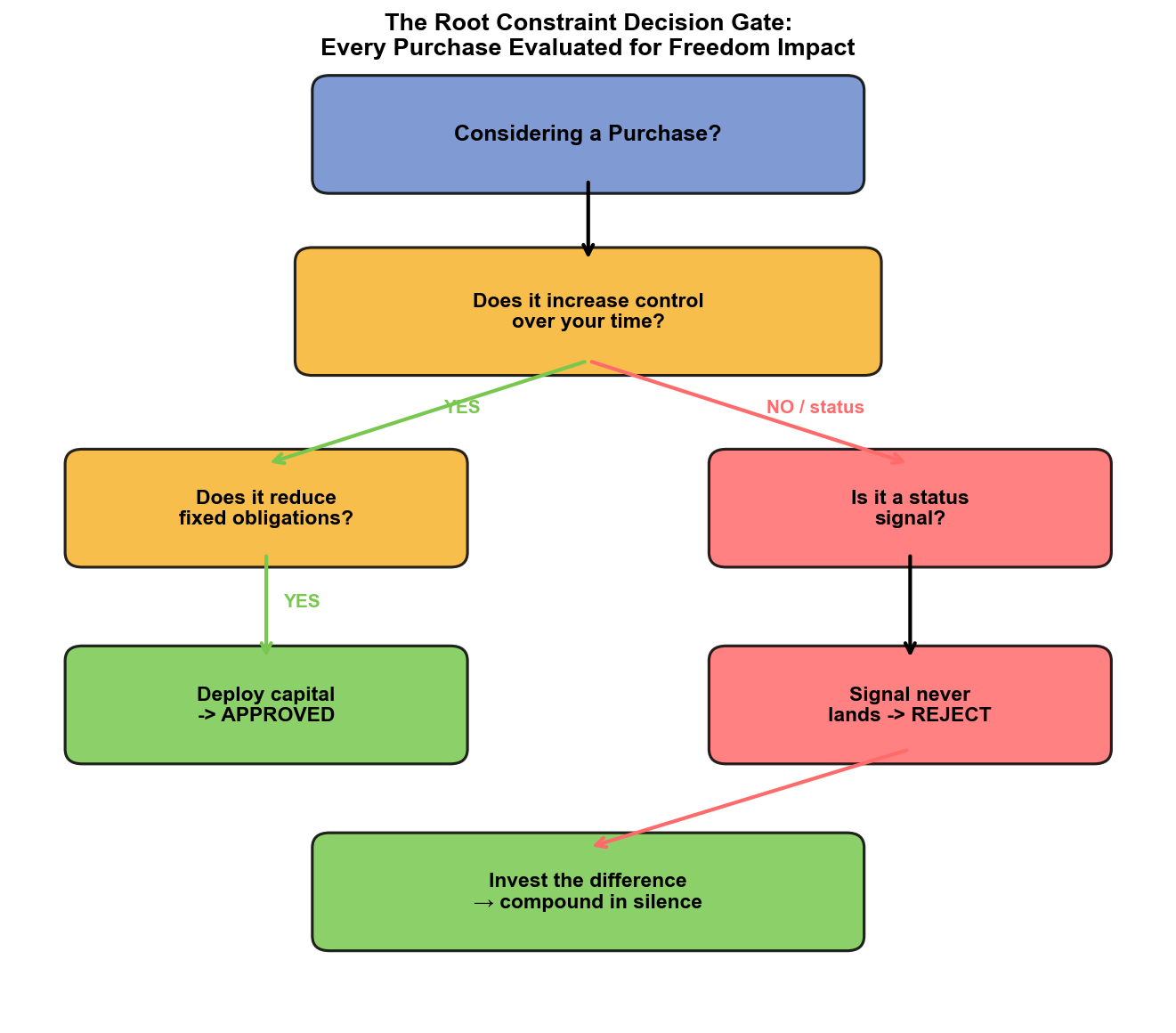
Every purchase enters at the top. It exits either as deployed capital toward freedom or as redirected savings compounding in silence. The gate is not a moral judgment — it is an objective function evaluation.
This article is adapted from Chapter 2 of Debugging Your Personal Finance, which builds the full architecture of the freedom-first operating system — including the commute tax calculation, the Freedom Cost Matrix, and the quantified fragility framework. Chapters 5 and 8 extend the DOF concept into a full liquidity architecture and human-capital model.