The single most common reason people give for not investing is that they do not have enough money to bother. It is also the belief that costs them the most, because it inverts how compounding actually works. You do not need a lump sum. You need a small, automatic, repeated deposit and enough time for the exponent to do its job.
Here is what fixed monthly deposits become over 30 years at about 7% real return — the long-run average of a diversified stock index, after inflation.
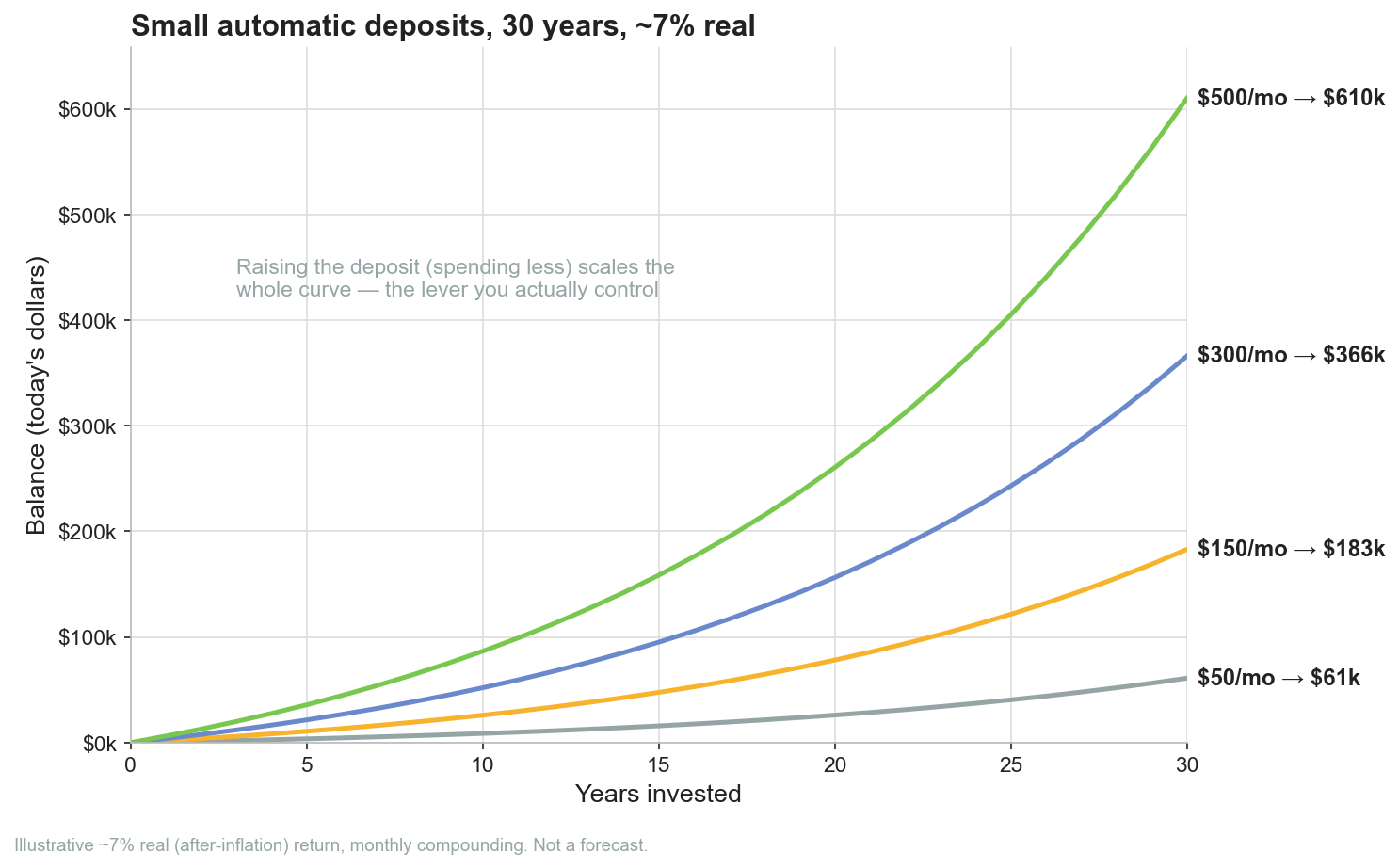
$50 a month — the price of a couple of takeout meals — becomes about $61,000. Nudge it to $150 and it is $183,000. This is the number the “I don’t have enough to invest” belief never sees: small is not the same as pointless.
Two engines, and you only control one
A portfolio has exactly two inputs: the rate of return and the contribution. Almost all financial media is about the first one — which fund, which timing, which forecast. But look again at the equation for a stream of deposits:
FV = PMT × [ ((1 + r)^n − 1) / r ]The return r is real, it matters, and you have almost no control over it. Markets hand you what they hand you. The deposit PMT, on the other hand, is a dial on your own budget, and the outcome is linear in it: the four lines in the chart are just the $50 line scaled up. Triple the deposit, triple the ending balance — with certainty, no market cooperation required.
That is why “spending less” is not a side quest to investing; it is the investing. Cutting $150 a month of spending you will not miss and routing it into an index fund is a $183,000 swing over 30 years — and unlike a bet on higher returns, it is entirely inside your control. The highest-leverage move available to a small investor is almost never a better fund. It is a bigger, automatic deposit.
Why “small and automatic” beats “large and eventual”
The instinct is to wait until you can invest a meaningful amount. The math punishes it twice.
First, the early deposits get the most compounding periods, so they are worth the most — the $50 you invest today outgrows the $50 you invest in five years by whatever the exponent does in between. Waiting to invest a bigger number means skipping the exponent’s best, earliest years.
Second, automation defeats the actual enemy, which is you. A one-time decision to invest “when I have enough” competes every month with a hundred other uses for the money, and usually loses. A standing transfer of $100 on payday competes with nothing — it happens before you can talk yourself out of it. Pay yourself first is not a slogan; it is the observation that willpower is a depleting resource and a scheduled transfer is not.
How to actually start, mechanically
The barriers that used to make small-dollar investing pointless are gone:
- No minimums, fractional shares. Most major brokerages let you buy a slice of a fund with whatever you have. $50 buys $50 of the index, not “nothing until you reach $1,000.”
- One broad, low-cost fund. A total-market or S&P 500 index fund or ETF is a complete, diversified portfolio in one holding. You do not need to pick five things.
- Automate the deposit, not the timing. Set a fixed transfer on payday. Buying the same dollar amount every month regardless of price is dollar-cost averaging — it removes the timing decision that paralyzes most beginners.
- Then raise it on a schedule. The single best habit: every raise, push your deposit up by part of it before lifestyle absorbs the rest. The $50 line becomes the $150 line without ever feeling a cut.
The one number that can quietly undo all of it
Because contributions are linear and small, fees are not small against them. A 1% annual fee does not sound like much, but it is subtracted from your r every year, and it compounds against you exactly the way returns compound for you — it can quietly eat a fifth or more of a 30-year balance. When the whole strategy is “small deposits, long time,” a low expense ratio (think a few hundredths of a percent, not one percent) is not a detail. It is the difference between the green line and something noticeably below it.
Start with whatever you can automate this week — $25, $50, $100. The amount is almost beside the point at the beginning; the habit and the start date are what compound. Then let raises do the rest. The engine you control is the deposit, and it is a bigger engine than the one everyone argues about.
The ~7% real figure is a long-run average used to illustrate the mechanics, not a forecast; actual returns vary, stocks are volatile, and past performance does not guarantee future results. This is educational content, not financial advice.