Between the day Tesla was announced for the S&P 500 and the day it was actually added, its split-adjusted price rose about 59 percent, and the index funds that had to buy it paid the higher price. That gap is a small, mostly hidden cost of pure index tracking, and almost no index investor ever sees it on a statement.
Here is the setup. The S&P 500 is a rules-based list of large US companies. Trillions of dollars sit in funds whose only job is to hold that exact list in the exact weights the index publishes. When the committee that runs the index swaps one company out and a new one in, every one of those funds is contractually obligated to match the change. They are not deciding whether the new stock is a good buy. They are forced buyers, and the market knows it in advance. That knowledge is what creates the cost, and you can watch it play out in Tesla’s price path from the announcement through the effective date.
How An Addition Actually Works
An index change happens in two steps separated by a few days to a couple of weeks, and the gap between them is where the action is.
The first step is the announcement. S&P Dow Jones Indices, the company that maintains the index, publishes a press release stating that a named company will be added, and it names the effective date. For Tesla, that release went out after the market close on November 16, 2020, and it set the effective date as before the open on December 21, 2020. The announcement is public the instant it drops. Anyone watching can act on it the next morning.
The second step is the effective date. That is the moment the new stock is officially inside the index. From that point forward, any fund that promises to track the S&P 500 must hold the new stock in its index weight or it will drift away from the benchmark it is paid to match. So index funds concentrate their buying around that date. In practice, a fund that reprices against the closing values on the last trading day before the effective date executes its purchase near that close, which for Tesla was the close on Friday, December 18, 2020, with the effective date the following Monday.
Now put yourself in the seat of a trader who is not an index fund. You read the November 16 announcement. You know, with near certainty, that a very large, price-insensitive wave of buying is coming on a specific date about five weeks out, because the index funds have no choice. The rational move is to buy the stock now, hold it into that forced demand, and sell into it. That behavior is called front-running the index, and it is legal because the information is public. When many traders do it at once, they bid the price up well before the index funds even show up. By the time the funds buy on the effective date, they are buying from exactly the traders who loaded up early, at a price those traders helped inflate.
That is the mechanism in one sentence. A known, forced, price-insensitive buyer on a known date invites everyone else to buy first, so the forced buyer tends to pay a premium.
The Tesla Case, Measured
Tesla is the cleanest large example we have, because its addition was unusually big and unusually well telegraphed. It was the largest company ever added to the index at the time, and its eventual index weight was so large that S&P even ran a public consultation on whether to phase it in over two steps before deciding to add it all at once. Every index fund manager on the planet knew the buy was coming.
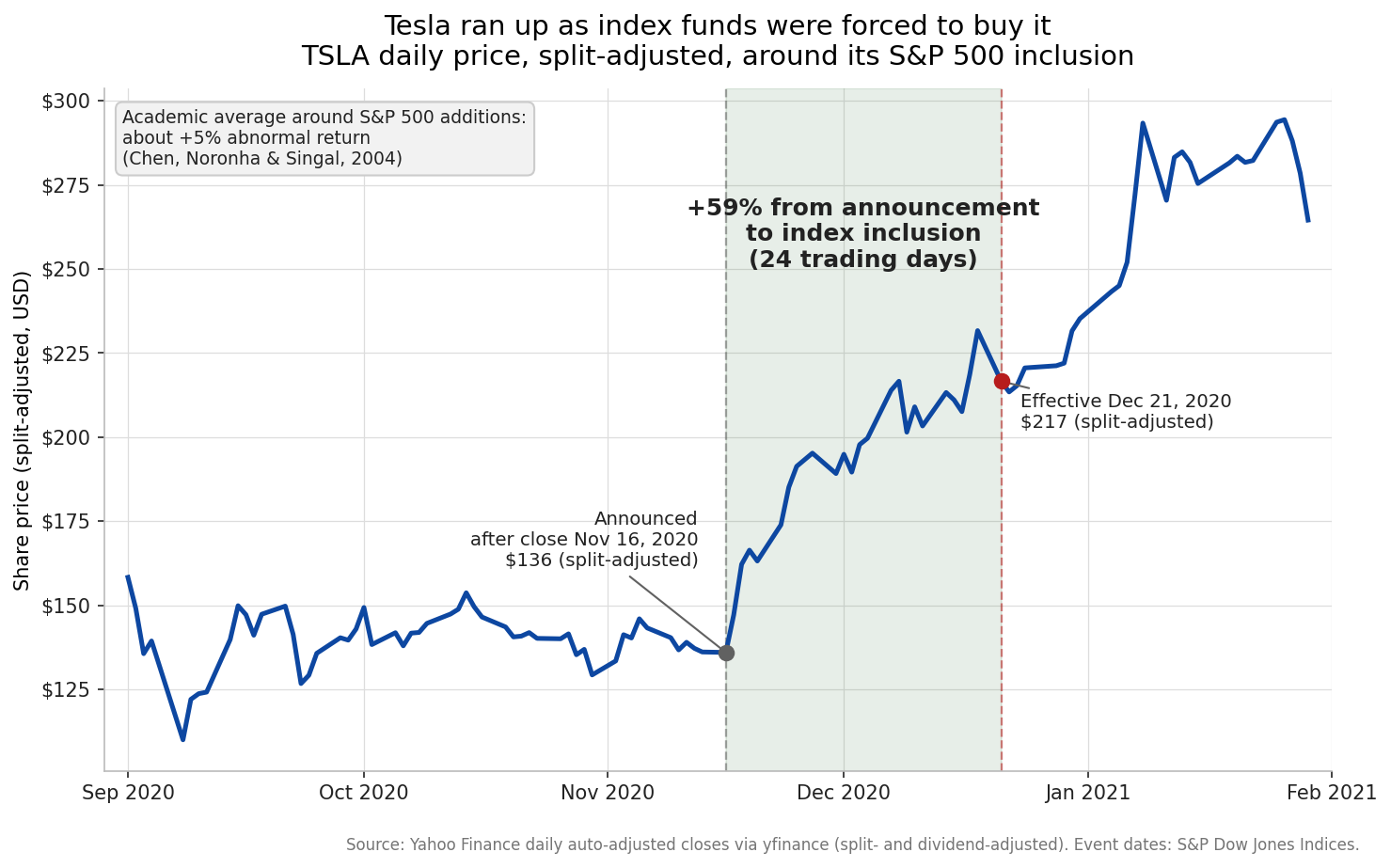
I pulled Tesla’s daily prices from Yahoo Finance, auto-adjusted so that the later three-for-one stock split from 2022 is folded back in and every price sits on today’s split-adjusted basis. On that basis the numbers are these. At the November 16, 2020 close, the day of the announcement, Tesla traded at about 136 dollars. By the close on December 18, 2020, the last trading day before it entered the index and the point where index funds executed, it had reached about 232 dollars. That is a run-up of roughly 70 percent in the 23 trading days between the announcement and the forced buy. On the effective date itself, December 21, the stock closed near 217 dollars, having given back some of the spike as the forced buying was absorbed. Measured from the announcement close to the effective-date close, the gain was about 59 percent.
Go back to the chart above and the whole story is there. Tesla drifts sideways around 135 to 150 dollars through September and October of 2020, then the announcement lands and the line launches almost vertically through the shaded window between the two event dates, peaking right at the moment index funds had to buy. The green shaded band is that announcement-to-inclusion interval. The run-up is not subtle. It is the steepest, cleanest move on the chart, and it happens exactly where theory says the forced-buyer premium should show up.
An index fund tracking the S&P 500 could not have bought Tesla at 136 dollars. Its mandate was to hold Tesla at its index weight starting on the effective date, so it bought around the effective date, near the top of that run. The roughly 59 percent gap between the announcement price and the inclusion price is money that flowed from index-fund holders, who own the fund, to the traders who bought early. No line item on a fund statement labels this. It shows up only as a benchmark that was a hair harder to beat, and as a stock that entered the index expensive.
The Academic Average, And Why Tesla Overstates It
One vivid case can mislead, so it is worth anchoring to the broad evidence. The classic study is by Honghui Chen, Gregory Noronha, and Vijay Singal, published in the Journal of Finance in 2004. Looking at additions to the S&P 500, they found an average abnormal return of roughly 5 percent around the addition. Abnormal return means the stock’s move after stripping out whatever the overall market did over the same window, so it isolates the piece attributable to the index event itself. Their work also documented an asymmetry: additions produced a lasting price bump, while deletions showed a different pattern, which pointed toward the forced-demand and awareness story more than a simple one-time liquidity blip.
Five percent, not fifty-nine. Tesla is an outlier by more than an order of magnitude, and the honest reading is that Tesla is the exception that makes the effect legible, not the typical case. Tesla combined a gigantic index weight, an unusually long and public runway, and a stock that was already in the middle of a historic momentum run for reasons that had nothing to do with the index. A routine addition of a mid-sized company that few traders bothered to front-run looks far more like the 5 percent number, and often less.
There is also good reason to think the effect has shrunk since the Chen, Noronha, and Singal sample. As indexing has grown into a larger share of the market, the mechanics have gotten more crowded and more anticipated, and index providers have varied their execution to blunt the front-running. When everyone expects the pop, arbitrageurs compete it down. Later research on additions has generally found the inclusion premium smaller and less reliable than it was in the 1990s. The direction of the effect is well established. The magnitude for any single ordinary addition today is small and uncertain.
Why This Is A Cost You Can Live With
It would be easy to read all of this as an indictment of index funds. It is not. The inclusion effect is a real cost, but it is a small one per event, and it sits inside a strategy that wins decisively on the costs that actually matter.
Start with how rarely it bites. The S&P 500 turns over only a handful of names in a typical year. A broad fund holds 500 stocks, so even a large one-time premium on a newly added name is diluted across the whole portfolio to something you would struggle to find in the fund’s tracking error. Multiply a 5 percent average premium by the tiny initial weight of a freshly added company and by the low frequency of additions, and the drag on the total fund is a rounding error next to the things that dominate long-run returns.
Now weigh it against what index funds save you. A broad S&P 500 index fund charges an expense ratio near a few hundredths of a percent a year, against well over half a percent for the average actively managed stock fund. It trades rarely, so it generates little in the way of taxable capital gains distributions. It does not pay a manager to guess. Those structural savings compound every year, on the entire balance, for as long as you hold. The inclusion premium is an occasional pinprick on the new names. The fee and tax advantage of indexing is a steady tailwind on everything you own. The second effect swamps the first by a wide margin over any long horizon.
The point of measuring the inclusion effect is not to scare anyone out of index funds. It is to understand that no tracking strategy is truly free, because tracking means being a forced, predictable buyer, and predictable buyers get front-run. The remarkable thing is how cheap that predictability turns out to be. You pay a few basis points of hidden slippage on rare additions in exchange for a strategy that has beaten most active managers after costs over almost every long window that has been studied.
What To Take From It
A few things follow from watching how an addition really works.
First, the inclusion pop is a demand effect, not a value signal. When a stock jumps on news that it is joining the index, nothing about the underlying business changed. A committee changed a list, and forced buyers plus front-runners moved the price. Treating index addition as a reason a stock is now a better investment gets the causation backward. The buying is mechanical, and mechanical buying is exactly the kind that reverses once it is done, which is why Tesla gave back part of its spike right at the effective date.
Second, funds that track less crowded or less rigidly scheduled indexes can sidestep some of this cost. A fund that does not have to buy a named stock on a named day is harder to front-run. Some index providers deliberately buffer their additions, phase them in, or keep changes quiet to reduce the premium their funds pay. If you ever compare two funds tracking similar exposures, the smarter one is often the one whose rebalancing is harder for the rest of the market to predict.
Third, keep the cost in proportion. The hidden slippage from index additions is real and worth knowing, and it is a small fraction of the fees, taxes, and trading costs that a typical active fund hands you instead. Understanding the inclusion effect makes you a sharper index investor. It should not make you a reluctant one.
The next time a company pops on the news that it is joining the S&P 500, you will know what you are watching. It is the sound of forced buyers arriving on a schedule everyone could see, and the price paying its respects to that certainty. Tesla just turned the volume all the way up.
Sources
- Yahoo Finance daily auto-adjusted (split- and dividend-adjusted) closing prices for TSLA. Every Tesla price and return in this article, including the announcement close of about 136 dollars, the pre-effective close of about 232 dollars, and the effective-date close of about 217 dollars, was computed directly from this data.
- S&P Dow Jones Indices, press releases announcing Tesla’s addition to the S&P 500 (announcement after the close on November 16, 2020; effective before the open on December 21, 2020).
- Honghui Chen, Gregory Noronha, and Vijay Singal, “The Price Response to S&P 500 Index Additions and Deletions: Evidence of Asymmetry and a New Explanation,” Journal of Finance 59, no. 4 (2004), for the roughly 5 percent average abnormal return around index additions and the addition-versus-deletion asymmetry.