One account lets you deduct the money going in, grow it with zero tax, and pull it out tax free. The IRS built exactly one like that, and most people use it as a checking account for copays. The Health Savings Account is quietly the most tax-efficient retirement vehicle in the entire code, and it hides in plain sight because its name says “health” and not “wealth.”
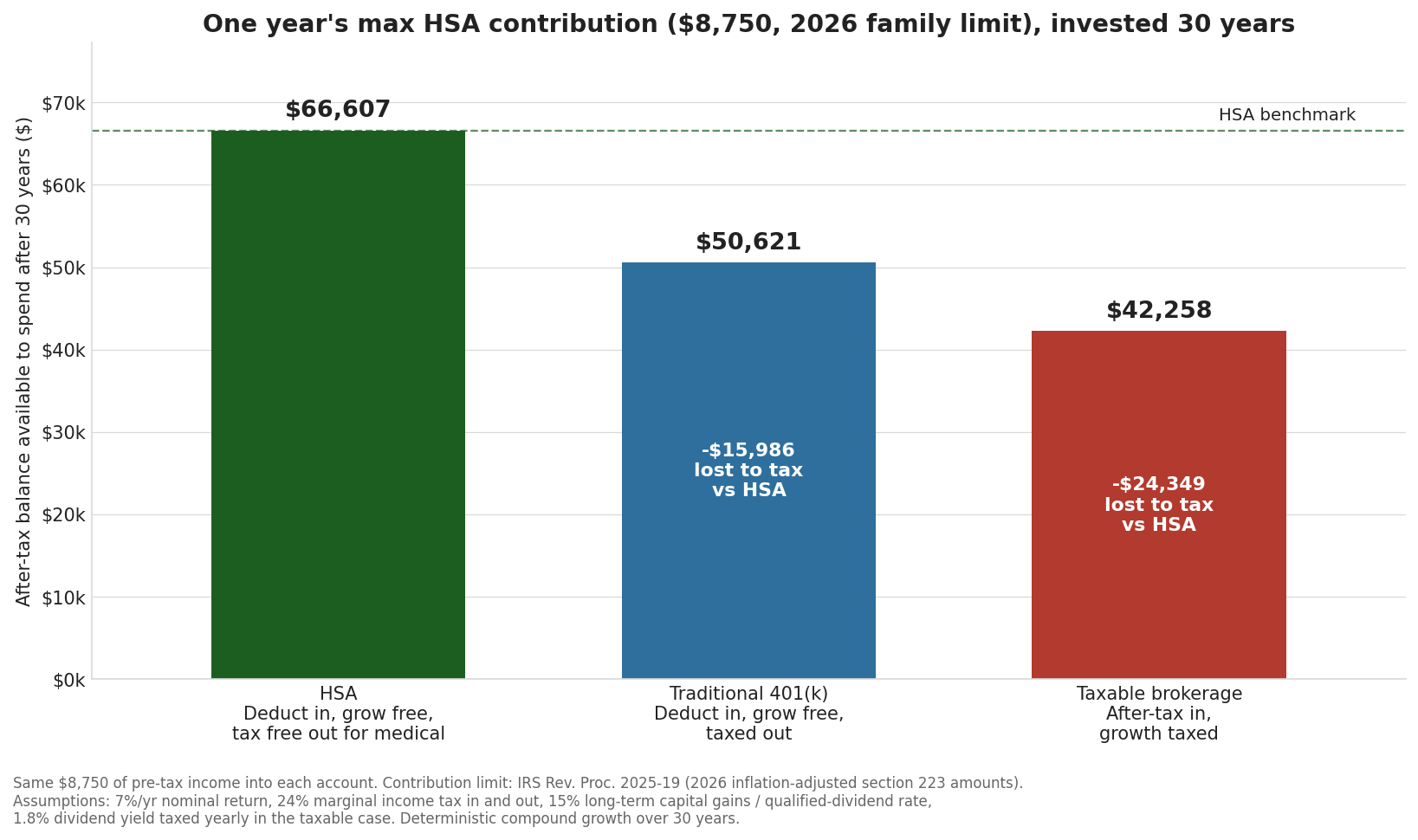
The mechanics are worth stating precisely, because the advantage is not a slogan. It is three separate tax breaks stacked on the same dollar. A 401(k) gives you two of them. A Roth IRA gives you a different two. The HSA is the only account that gives you all three at once, and when you let those three compound across a career, the gap over an ordinary taxable account is large enough to change how you think about which account to fund first. The chart below puts numbers on that gap, following one year’s contribution through three accounts for 30 years.
Three Tax Breaks on One Dollar
Every dollar you invest passes through three tax gates. It gets taxed when you earn it. It gets taxed while it grows, through taxes on dividends and capital gains. It gets taxed again when you spend it, if it sits in a pre-tax account like a Traditional 401(k). Different accounts close different gates. The HSA is the only one that closes all three.
Start with the first gate. HSA contributions are deductible above the line, which means you subtract them from your income whether or not you itemize, according to IRS Publication 969. Put in 4,000 dollars at a 24 percent marginal rate and your tax bill drops by roughly 960 dollars that year. If you contribute through payroll, the money also escapes the 7.65 percent Social Security and Medicare payroll tax, a break that even a Traditional 401(k) does not give you. That is money the government would otherwise have taken, redirected into an account you own.
The second gate is the one people underestimate. Inside the HSA, dividends and capital gains are never taxed. There is no annual drag, no 1099 to reconcile, no tax owed when you rebalance. A taxable brokerage account bleeds a little every year to taxes on distributions, and that leak compounds against you the same way a fund fee does. The HSA has no such leak.
The third gate is where the HSA stands alone. When you withdraw the money to pay a qualified medical expense, you pay no tax on the withdrawal at all, at any age, per IRS Publication 969. A Traditional 401(k) closes the first two gates and then taxes you fully on the way out. A Roth IRA taxes you on the way in and then closes the last two. The HSA closes all three, and medical spending is one category of expense every human being is guaranteed to have.
The setup behind the figure above is simple. Take one year’s maximum family contribution, the 8,750 dollars allowed for 2026 under IRS Revenue Procedure 2025-19, and route the same pre-tax income into three accounts. Grow each at an assumed 7 percent per year for 30 years, and assume a 24 percent marginal income tax rate on the way in and out, with a 15 percent rate on long-term gains and qualified dividends. Those return and tax numbers are assumptions I have chosen to be reasonable, not forecasts, and the compounding math itself is deterministic.
The HSA dollar grows to about 66,600 dollars, and you keep every cent of it for medical costs. The Traditional 401(k) grows to the same gross figure and then loses about 16,000 dollars to income tax on withdrawal, landing near 50,600. The taxable account is worse on both ends. You had to pay income tax before you could invest, so less went in, and then the annual tax on dividends plus the capital gains tax at the end drag it down to roughly 42,300 dollars. On a single year’s contribution, the HSA keeps about 24,000 dollars more than the taxable account. Multiply that across a career of annual contributions and the difference becomes a meaningful fraction of a retirement.
The Catch, Stated Honestly
None of this is free, and the eligibility rule is strict enough that many people cannot use an HSA at all. To contribute, you must be covered by a qualifying high-deductible health plan and by nothing that disqualifies you, according to IRS Publication 969. The high deductible is the price of admission.
For 2026, IRS Revenue Procedure 2025-19 defines a qualifying plan as one with an annual deductible of at least 1,700 dollars for self-only coverage or 3,400 dollars for family coverage, with annual out-of-pocket maximums no higher than 8,500 and 17,000 dollars respectively. You also cannot be enrolled in Medicare, cannot be claimed as someone else’s dependent, and cannot have disqualifying secondary coverage such as a general-purpose flexible spending account. If you are enrolled in Medicare, your window to contribute has closed, though the money already inside keeps its tax treatment.
The high-deductible plan is a real trade-off. You are betting that your out-of-pocket medical costs will be low enough that the lower premiums and the tax break outweigh the higher deductible. For a healthy individual or family with steady cash flow, that bet often pays. For someone with high, recurring medical costs and little slack in the budget, a lower-deductible plan can be the better choice even after giving up the HSA. The account is a powerful tool, and it is the wrong tool for some people. Honesty about that is part of using it well.
The contribution limits themselves are modest, which is why the account rewards starting early. For 2026 the maximum is 4,400 dollars for self-only coverage and 8,750 dollars for family coverage, per Revenue Procedure 2025-19. If you are 55 or older, you can add a 1,000 dollar catch-up contribution, an amount fixed by statute that does not adjust for inflation, according to IRS Publication 969. These are annual ceilings, so the account grows through patience and repetition, one funded year at a time.
The Receipt Shoebox
Here is the strategy that turns a medical account into a retirement account, and it depends on a single feature of the rules that almost nobody exploits. There is no deadline for reimbursing yourself from an HSA.
The IRS allows you to pay a qualified medical expense out of your own pocket today, keep the receipt, leave the money in the HSA to compound, and reimburse yourself for that expense years or even decades later, entirely tax free. The only conditions, spelled out in IRS Publication 969, are that the expense was incurred after you opened the HSA, and that you did not already deduct it on a tax return or reimburse it from another account. Nothing in the rules requires the reimbursement to happen in the same year, or the same decade.
Think through what that permits. Suppose you spend 500 dollars on a qualified medical bill this year and pay it with a credit card. You save the receipt in a folder, digital or paper, and you leave 500 dollars invested inside the HSA. Over 20 years at 7 percent, that 500 dollars grows to roughly 1,935 dollars inside the account, untouched and untaxed. Two decades from now you can reimburse yourself the original 500 dollars, tax free, and the extra 1,435 dollars of growth stays in the HSA to keep compounding. You have effectively used a past medical bill as a claim on tax-free cash you can draw whenever you want.
The receipt shoebox converts the HSA into a Roth-like account with a tax-free withdrawal option you can trigger at will, as long as you have unreimbursed medical expenses on file. Most households accumulate thousands of dollars of qualifying receipts over a lifetime without trying, since the definition covers dental work, vision, prescriptions, many over-the-counter items, and a long list of other costs detailed in IRS Publication 502. The discipline required is small. Pay out of pocket when you can afford to, save the paperwork, and let the account do what tax-free compounding does.
After 65, the Floor Disappears
The one real restriction on an HSA is that penalty-free withdrawals must go toward qualified medical expenses. Pull money out for a car or a vacation before age 65 and you owe ordinary income tax on it plus a 20 percent penalty, according to IRS Publication 969. That penalty is the fence that keeps the account pointed at health costs.
At age 65, the fence comes down. Once you turn 65, the 20 percent penalty on non-medical withdrawals disappears entirely. You still owe ordinary income tax on any dollars you withdraw for non-medical purposes, which is exactly how a Traditional IRA or 401(k) already works, per IRS Publication 969. Withdrawals for qualified medical expenses remain completely tax free, at 65 and beyond.
Read what that does to the account’s worst case. Before 65, the HSA is a triple-tax-free medical account with a penalty for misuse. After 65, it becomes a triple-tax-free medical account with no downside, because the non-medical option has simply become a normal pre-tax retirement account. You get the best case if you spend it on health care, which in retirement is close to guaranteed, and you get an ordinary tax-deferred account if you do not. There is no scenario after 65 in which the HSA is worse than the 401(k) you were already going to fund, and there are many in which it is strictly better.
Health care is also the one expense that reliably rises in retirement. Fidelity’s annual estimate has long put lifetime retiree medical costs in the six figures for a couple, and Medicare premiums, dental, vision, hearing, and long-term care are all qualified expenses you can pay from the HSA tax free. The account is built for precisely the bill you are most certain to face.
Where the HSA Belongs in the Stack
The practical question is not whether the HSA is powerful. The math settles that. The question is where it sits in the order you fund your accounts. A defensible priority for someone eligible is to first capture any employer 401(k) match, because that is an immediate return no account can beat, then to fund the HSA to its limit, and then to return to the 401(k) and other accounts. The HSA earns that high placement because it is the only account that closes all three tax gates, and because the age-65 rule removes its only real risk.
One habit protects the whole strategy. If your cash flow allows it, contribute the maximum, pay current medical bills from other money, and invest the HSA balance in the same low-cost index funds you would hold anywhere else, since an HSA left in cash earns almost nothing and wastes the tax shelter around it. The tax advantages only matter if the money is actually invested and actually left to grow. Treat the account as the long-horizon investment vehicle it is, keep your receipts, and let the three tax breaks compound on the same dollar for as long as you can leave them alone.
Sources
- Internal Revenue Service, Revenue Procedure 2025-19, 2026 inflation-adjusted amounts for Health Savings Accounts under Section 223 (self-only limit 4,400 dollars, family limit 8,750 dollars, and the 2026 high-deductible health plan thresholds). https://www.irs.gov/pub/irs-drop/rp-25-19.pdf
- Internal Revenue Service, Publication 969, Health Savings Accounts and Other Tax-Favored Health Plans (eligibility, the deduction, tax-free growth and qualified withdrawals, the 55-and-older catch-up, the 20 percent penalty before 65, and the age-65 rule). https://www.irs.gov/publications/p969
- Internal Revenue Service, Publication 502, Medical and Dental Expenses (what counts as a qualified medical expense). https://www.irs.gov/publications/p502
- Compound-growth comparison of one year’s 2026 family HSA limit invested 30 years at an assumed 7 percent return, a 24 percent marginal income tax rate, and a 15 percent long-term capital gains rate.