Nassim Taleb spent years as a derivatives trader before becoming one of the most rigorous thinkers on risk and systemic fragility. One of his most uncomfortable observations concerns modern employment: companies treat their employees as operational expenses, not capital investments.
If a machine breaks down, the company records a capital loss. The balance sheet takes a hit. There is a quantifiable cost. But if an engineer burns out, makes a career change, or gets laid off, the company records a replacement cost, typically a fraction of the engineer’s total compensation, and moves on. No capital loss. No balance sheet impact. The engineer is a line item in the operating budget, not an asset on the balance sheet.
Taleb calls this the OpEx-CapEx asymmetry. And it has a direct implication for how engineers should think about their own financial structure: the company has no systemic obligation to maintain the relationship. The engineer is structurally replaceable. And if the engineer’s financial life is built entirely around the continuity of that income, they have handed all of their optionality to an entity that views them as an operational line item.
This is the engineering definition of financial fragility.
What $400k Actually Buys
The tech compensation packages that generate headlines ($300k, $400k, $500k total compensation) are routinely mistaken for financial security. They are not. Financial security is a property of the relationship between income and fixed obligations, not a property of income in isolation.
Consider a common profile: a senior engineer at a major tech company earning $400,000 in total compensation (salary, bonus, and vesting equity). Their monthly fixed obligations look like this:
| Obligation | Monthly Cost |
|---|---|
| Mortgage (3,500 sq ft home) | $4,200 |
| Two car payments (leased) | $1,800 |
| Private school tuition | $2,500 |
| Subscriptions and memberships | $800 |
| Minimum debt service | $700 |
| Total Fixed | $10,000/month |
At $400k gross, after federal and state taxes in California, monthly net is approximately $20,000. Fixed obligations consume 50% before a single discretionary dollar is spent.
Now model a layoff. The income line drops to zero. The fixed obligation line stays at $10,000 per month. The engineer has, at most, whatever liquid savings they have accumulated, often surprisingly little given the high spending rate, before they are forced to accept the next available role at whatever salary the market offers in a compressed job search.
That is not a $400k earner’s financial situation. That is a $400k earner’s financial fragility.
Taleb’s Fragility Definition, Applied
Taleb defines a fragile system as one where volatility produces disproportionate downside. A fragile wine glass does not get a little damaged when dropped. It shatters. The response to disruption is nonlinear and catastrophic relative to the size of the disruption.
A financially fragile engineer has the same property. A 90-day layoff, a minor operational disruption to a company, triggers a cascade of forced decisions: the first job offer gets accepted regardless of fit or salary, assets may need to be liquidated at unfavorable prices, and the psychological negotiating position is zero. The disruption is small from the company’s perspective. The engineer’s experience of it is disproportionately large.
The fragility score makes this precise:
Fragility Score = Monthly Fixed Obligations / Monthly Net Income| Score | Interpretation |
|---|---|
| > 0.7 | Highly fragile: 70%+ of income pre-committed, minimal shock absorption |
| 0.5 – 0.7 | Fragile: limited buffer, any income disruption triggers stress |
| 0.3 – 0.5 | Moderate: some buffer, manageable disruptions |
| < 0.3 | Antifragile: high optionality, income disruptions are inconveniences |
The $400k engineer with $10,000/month in fixed costs and $20,000/month net income has a fragility score of 0.50, in the fragile range, despite the headline compensation. A significant income disruption (layoff, forced role change, health event) activates a cascade.
The engineer earning $150k with $2,000/month in fixed costs and $7,500/month net income has a fragility score of 0.27, antifragile, despite the lower headline number.
Income level does not determine fragility. The ratio of obligations to income does.
The Golden Handcuffs Mechanism
The golden handcuffs pattern is a specific variant of financial fragility where the high income becomes the trap instead of the escape.
The mechanism works in three phases:
Phase 1: Lifestyle expansion. As income increases, spending increases to match. The mortgage upgrades. The cars upgrade. The schools upgrade. This is the default trajectory in the absence of a rewritten root constraint: income maximization produces spending maximization, which produces obligation maximization.
Phase 2: Lock-in. Fixed obligations now require the current income level to service. The engineer cannot accept a role at 20% less compensation without restructuring their entire lifestyle, a painful, socially visible downgrade. They cannot take a sabbatical to explore a career pivot. They cannot walk away from a toxic manager without an immediate replacement offer in hand. Every option that requires accepting less money is structurally blocked.
Phase 3: Fragility crystallized. The engineer is now fully dependent on continuous income at the current level. Any disruption (layoff, recession, health event, company failure) triggers an emergency. They are forced to sell their most valuable asset (their human capital and negotiating leverage) under duress, typically accepting significantly below-market terms because the timeline for a considered search has been eliminated by the fixed obligation clock.
The golden handcuffs are not imposed externally. They are self-constructed, one lifestyle upgrade at a time, each of which seemed individually reasonable.
“Fuck You Money”: The Engineering Definition
Taleb’s term for the antidote to fragility is deliberately crude: “Fuck You Money.” The crudeness is intentional: it communicates the precise function of the reserve without softening it into something polite and therefore forgettable.
In engineering terms, Fuck You Money is the minimum viable buffer, the liquid capital required to maintain optionality during a system failure. It is the reserve that allows you to decline a bad offer, end a toxic employment relationship, or take three months to find the right role instead of the available one.
The exact size depends on your monthly fixed obligations and your desired runway:
Minimum FYM = Monthly Fixed Obligations × Target Runway (months)At $10,000/month in fixed costs, a 12-month runway requires $120,000 in liquid, accessible capital, not equity, not retirement accounts, not home equity. Liquid. The buffer is worthless if it cannot be deployed within days of a disruption.
At $2,000/month in fixed costs, a 12-month runway requires only $24,000. This is why reducing fixed obligations is structurally more powerful than increasing income for building optionality: it reduces the size of the buffer required to achieve the same degree of freedom.
The contrast is clearest side by side, in the figure below.
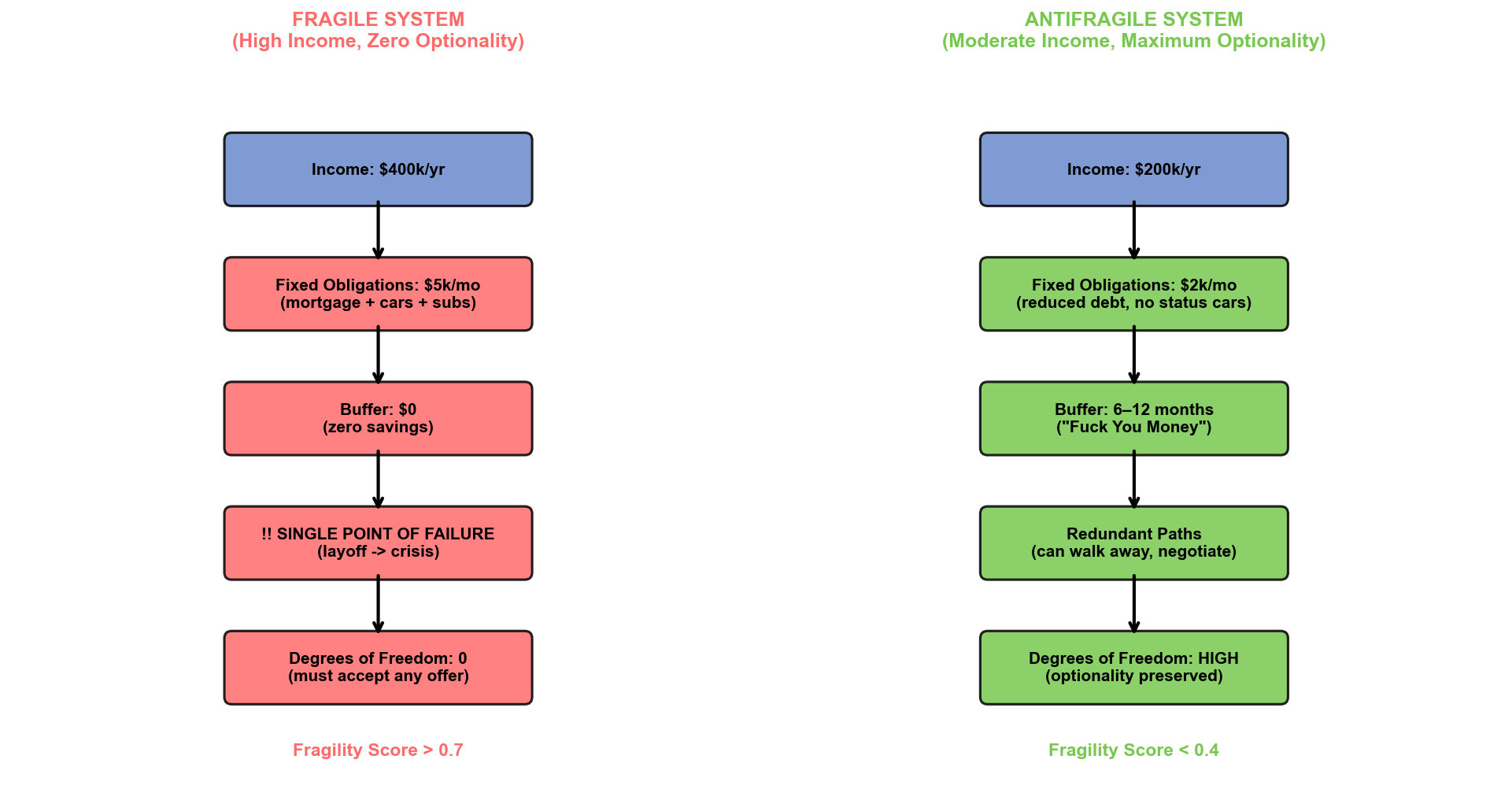
The left system (high income, high fixed obligations, zero buffer) has zero degrees of freedom. Any disruption triggers a forced decision. The right system (moderate income, low fixed obligations, adequate buffer) has multiple redundant paths. Disruptions are inconveniences, not emergencies.
The Restructuring Protocol
If you run your fragility score and find yourself in the fragile range, the restructuring is not complex, but it requires treating fixed obligations as the primary target, not income as the primary variable.
Step 1: Audit fixed obligations. List every recurring monthly commitment that cannot be immediately cancelled: mortgage, car payments, debt service, insurance premiums, subscriptions with contracts. This is your fixed cost base. It is the number that determines how much liquid reserve you need and how many months you can survive a disruption.
Step 2: Eliminate the highest-fragility obligations first. Leased vehicles are a high-fragility obligation: fixed monthly cost, no equity accumulation, termination penalties. Subscriptions and memberships are low-fragility (easily cancelled) but high in aggregate. Debt service is the most damaging because it compounds against you during the disruption period.
Step 3: Build the buffer before increasing lifestyle. Every income increase (raise, bonus, vesting event) goes to the buffer first until the fragility score is below 0.3. No lifestyle upgrade proceeds until the buffer exists, because the lifestyle upgrade increases fixed obligations while the buffer reduces them.
Step 4: Treat the buffer as infrastructure, not savings. The minimum viable buffer is not money you are building toward a goal. It is the foundational layer of your financial architecture: the same way a server’s redundant power supply is not optional equipment, it is required infrastructure. It must exist before anything else is built on top of it.
The goal is not to be rich. The goal is to be impossible to coerce. Those are different objectives, and only one of them is reliably achievable regardless of what the market pays engineers next year.
This article is adapted from Chapter 2 of Debugging Your Personal Finance, which introduces the fragility framework alongside the OpEx-CapEx asymmetry. Chapter 5 builds this into a full four-quadrant liquidity architecture, distinguishing between emergency reserves, opportunity capital, and long-term accumulation, so that each dollar is deployed at the correct layer of the financial stack.