For decades, the financial industry sold a simple story: smart people make better investment decisions, and better investment decisions produce better outcomes. IQ-adjacent proxies — elite degrees, quantitative backgrounds, prestigious employers — were treated as leading indicators of financial success. The implicit assumption was that the same analytical horsepower that makes someone an excellent engineer or scientist would translate into superior wealth accumulation.
The data do not support this story.
In 2011, researchers published findings from the Dunedin Study — a longitudinal analysis tracking approximately 1,000 individuals from birth to age 45 in Dunedin, New Zealand. The study controlled for IQ, social class, and family background, then measured financial health outcomes across the cohort. The result was not what the financial industry would predict.
The single strongest predictor of financial health at age 45 was not IQ. It was not income. It was not the prestige of the university attended. It was self-control — specifically, the capacity to defer gratification, maintain consistent behavior under pressure, and resist impulsive financial decisions.
This finding has a specific name in investment theory. It is called behavioral alpha.
What Behavioral Alpha Actually Means
In finance, alpha refers to excess return above a benchmark. Market alpha — beating the index — is theoretically possible but empirically rare. After fees, taxes, and transaction costs, fewer than 10% of actively managed funds outperform their benchmark index over a 15-year horizon. The more sophisticated the strategy, the harder it is to sustain the edge, because markets price in known advantages quickly.
Behavioral alpha is different in kind. It is not derived from superior information, analytical skill, or market timing. It is derived from not doing the things that destroy returns — and those things are reliably, consistently, statistically available to exploit.
The behavioral performance gap is well-documented. Studies of individual investor returns consistently show that the average investor earns meaningfully less than the funds they invest in — because they buy after strong performance and sell after drawdowns, compounding the market’s worst timing against themselves. This gap is not small. Across large samples, the behavioral gap between fund returns and investor returns has been measured at 1–2 percentage points per year. Over a 30-year horizon at 7% vs. 5% realized return, that difference compounds to roughly 65% less terminal wealth.
The investor who earns full market returns by doing nothing — buying a low-cost index fund on a fixed schedule and never touching it — is capturing behavioral alpha by the absence of bad behavior, not the presence of good stock picks.
The Marshmallow Test Was Measuring Affluence, Not Willpower
The Dunedin findings complicate a story many people learned in pop-psychology: the Stanford marshmallow experiment.
The famous version goes: in the 1960s and 70s, researcher Walter Mischel offered children a choice between one marshmallow now and two if they waited 15 minutes. Children who waited, according to the original narrative, showed better outcomes decades later — higher SAT scores, lower BMI, more life success. The conclusion drawn by a generation of self-help writers was that willpower is the fundamental trait separating high from low performers.
More recent reanalysis of the marshmallow data found a confounding variable: socioeconomic background. Children from higher-income families waited significantly longer — not because they had superior self-control, but because they had more reason to trust the system. The second marshmallow was reliably delivered when promised in their experience of the world. Children from less stable backgrounds ate the first one because, rationally, they had learned that promised future rewards frequently did not materialize.
The marshmallow test was measuring trust in institutions, not raw willpower. This matters for financial behavior because it reframes where the intervention point is. If behavioral alpha were purely a willpower problem, the solution would be discipline and character. If it is partly a systems design problem — whether the financial infrastructure is trustworthy and automatic — then the solution is engineering.
This is exactly what the data suggest.
The IQ Trap for High-Earning Engineers
The Dunedin result is particularly relevant for engineers, data scientists, and quantitative professionals — a cohort that is, by definition, analytically capable and accustomed to solving complex problems through reasoning and optimization.
The IQ trap manifests as a specific failure mode: the belief that analytical skill can substitute for behavioral consistency. Engineers routinely delay starting investments because they are “still evaluating the optimal strategy.” They market-time because they can build a model that suggests current valuations are stretched. They concentrate in individual stocks because they can analyze a company’s fundamentals. They complicate their allocation because simplicity feels intellectually unworthy of the problem.
Each of these behaviors is rational in isolation and catastrophic in aggregate. The evaluation delay costs years of compounding. The market-timing attempt produces underperformance relative to a simple buy-and-hold strategy in the overwhelming majority of backtested cases. The stock concentration introduces idiosyncratic risk that diversification eliminates for free. The complex allocation creates maintenance overhead and behavioral drag that a simple three-fund portfolio avoids entirely.
The high-IQ investor is not more protected from these failure modes. They are often more susceptible, because they can construct sophisticated justifications for each deviation from the boring, optimal strategy.
Behavioral Alpha Cannot Be Sustained by Willpower
Here is the practical implication that engineers in particular tend to resist: behavioral alpha is not a trait you maintain through conscious discipline. It is a property you engineer into the system.
Consider the analogy from software development. A team that depends on developers remembering to run tests before every commit will eventually ship a regression. Not because the developers lack discipline — they are conscientious professionals — but because manual processes fail under cognitive load, time pressure, and the thousand other demands of a working environment. The solution is not more discipline. It is a CI/CD pipeline that runs tests automatically, making it structurally impossible to merge code that has not been verified.
Financial behavior follows the same logic. A savings plan that depends on monthly willpower — remembering to transfer, resisting the temptation to spend the increment, maintaining conviction during a market drawdown — will eventually fail. Not because the investor lacks character, but because manual behavioral processes degrade under the conditions of real life.
The system design that captures behavioral alpha is not complex:
-
Automate savings on payday. The transfer happens before discretionary spending is available. The decision is removed from the monthly loop.
-
Invest automatically into index funds. No stock selection, no market timing, no rebalancing triggers based on headlines. The allocation runs on a schedule.
-
Remove the sell button from your default workflow. Do not have your brokerage app on your phone’s home screen. Create friction between anxiety and action.
-
Define a rebalancing rule in advance. Quarterly, or when allocations drift beyond a fixed threshold. Execute mechanically, not emotionally.
Each of these is a CI/CD pipeline for your finances. They do not require superior knowledge, exceptional IQ, or unusual discipline. They require a one-time system configuration that then runs correctly regardless of how the market behaves or how you feel on any given month.
The Boring Strategy Wins
The Dunedin Study’s conclusion, translated for a technical audience, is this: the wealth outcome is determined by the consistency of the behavior, not the sophistication of the strategy. And consistency of behavior is most reliably produced by system design, not willpower. The chart below captures what that difference does over time.
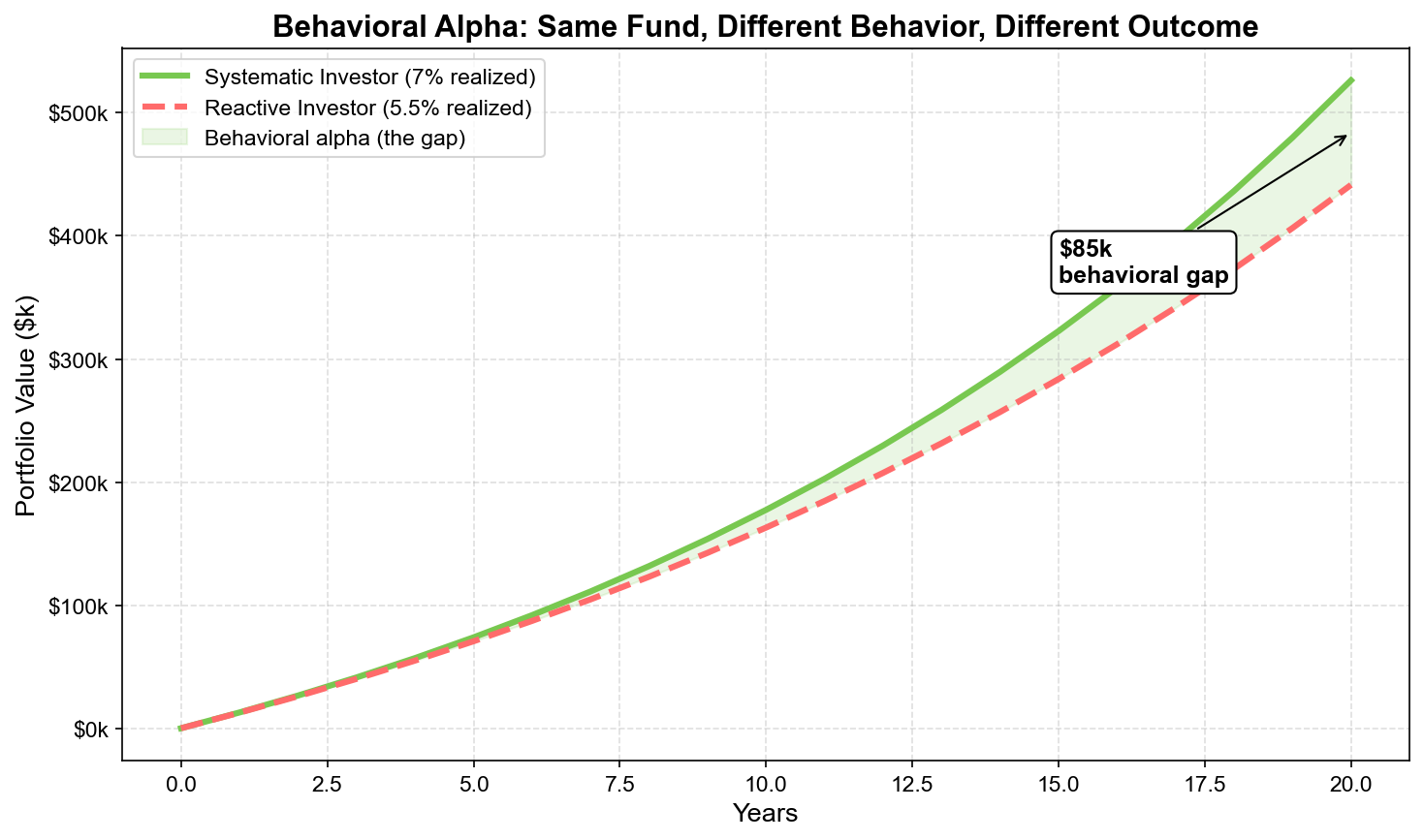
The chart above is not a chart about market returns. It is a chart about behavior. The upper curve is what happens when you maintain consistent positive inputs — automated savings, low-cost index funds, no panic selling, no behavioral drag. The lower curve is the cumulative effect of small, seemingly inconsequential deviations — delayed starts, skipped contributions, emotional selling, complexity overhead.
The gap is not produced by superior stock picks or better market timing. It is produced by the sign on the behavior exponent, compounded over years.
The wealthiest engineers are not the ones who earned the most or found the best investment. They are the ones who designed the most boring, automated, self-executing financial system — and then, critically, left it alone.
That is the entire secret. It is less interesting than it should be, and more powerful than most people believe.
This article is adapted from Chapter 1 of Debugging Your Personal Finance, which establishes behavioral alpha as the foundational operating principle of the entire book. The remaining chapters are the engineering blueprint for institutionalizing it — replacing monthly willpower with automated system design, from the capital allocation pipeline in Chapter 9 to the four-zone monitoring dashboard in Chapter 10.