The ETF where an AI picks the stocks has trailed the S&P 500 by five points a year since 2017. The funds that buy AI stocks got a different grade. Both results are worth reading carefully, because “AI ETF” is a label covering two products that have almost nothing in common, and the marketing for each borrows credibility from the other.
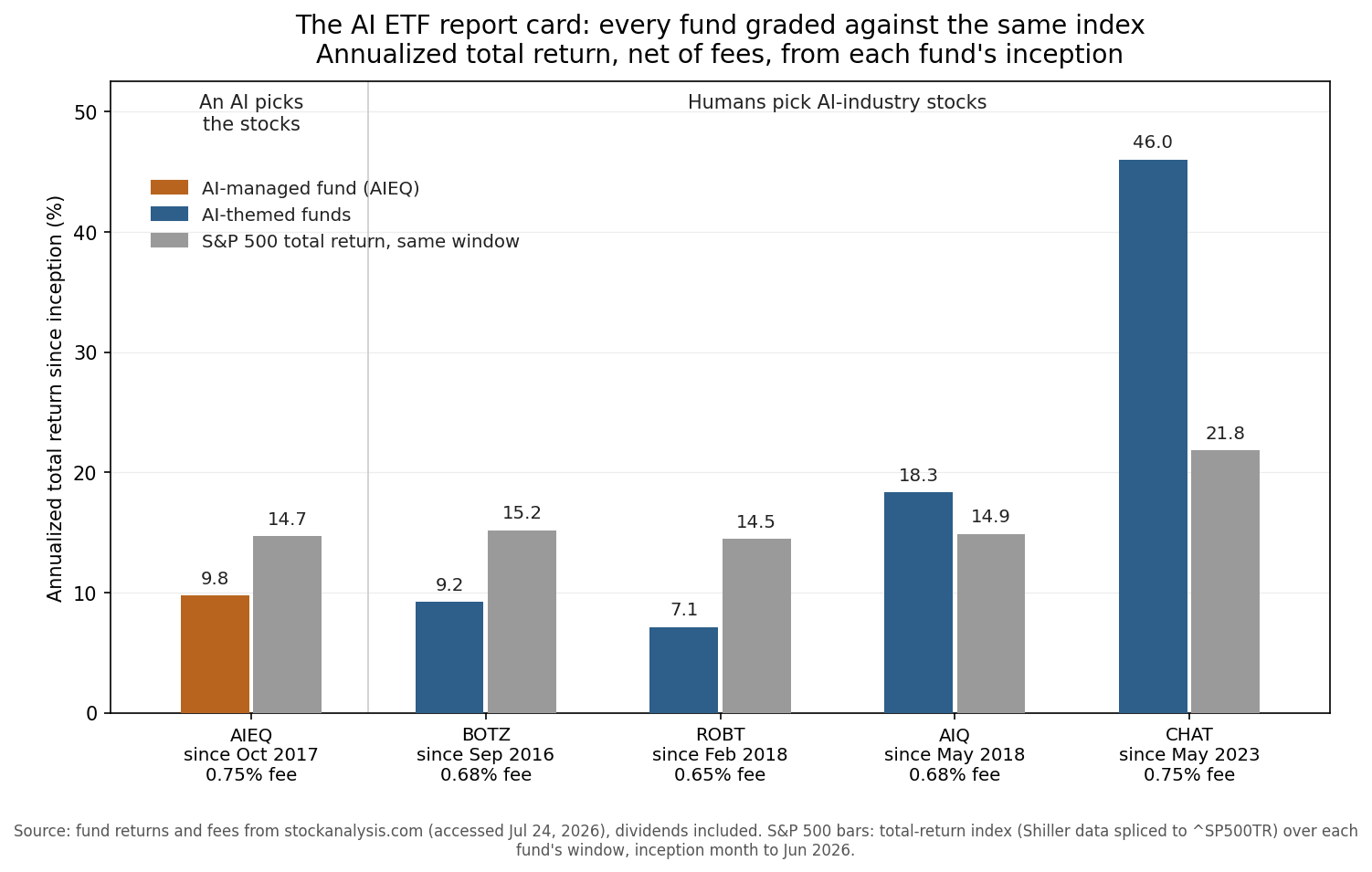
I write a data-driven personal finance series, and the house rule is that every number must trace to a dated primary source or get dropped. This piece applies that rule to five AI ETFs, the same treatment an earlier article in this series gave actively managed funds and the SPIVA scorecards. Each fund is graded against the S&P 500 total return over that fund’s own life, because a fund born in 2016 and a fund born in 2023 sat for different exams. All fund returns include dividends and are net of fees, pulled from stockanalysis.com on 2026; the index bars come from the S&P 500 total-return index over each fund’s window. Here is the full report card in one chart.
Two different products wear the same label
Before grading anything, separate the two species.
An AI-managed fund puts a model in the portfolio manager’s chair. The system reads filings, news, and market data, and it decides which stocks to buy. The flagship is AIEQ, launched in October 2017 as the AI Powered Equity ETF, built by EquBot on IBM’s Watson platform. The pitch was direct: a machine that reads millions of documents a day should out-pick humans. If you believe an AI can beat the market, this fund is the cleanest live test of that belief with real money attached.
An AI-themed fund is an entirely different machine. Humans, either an index committee or an active manager, pick companies that build or benefit from AI: chipmakers, robotics firms, cloud platforms. BOTZ, ROBT, AIQ, and CHAT are all in this category. Nobody claims the fund itself is intelligent. The claim is that the AI industry will grow and the fund will capture that growth.
One species bets on AI as a stock picker. The other bets on AI as an industry. The report card grades them separately because they fail, and succeed, in separate ways.
The fund where the AI does the picking
AIEQ has now run for almost nine years, through a bear market in 2018, a crash and recovery in 2020, a rate shock in 2022, and the AI boom itself. That is a real sample, long enough to grade. Since inception in October 2017 it returned 9.8 percent annualized with dividends, per stockanalysis.com as of 2026. Over the same window, October 2017 through 2026, the S&P 500 total return ran 14.7 percent annualized. The machine that reads everything trailed the index that reads nothing by about five points a year, every year, for nearly nine years.
Compounding turns that gap into a grade you can feel. Put $10,000 into each on day one. At 9.8 percent over the 8.67-year window, the AI picker grows it to roughly $22,500. At 14.7 percent, the plain index grows it to roughly $32,800. The investor who bought the boring index ended up more than $10,300 ahead on a $10,000 stake, a difference bigger than the original investment.
The fund is not a scam, and it did not blow up. It survived, which many niche funds from the 2017 vintage did not, and survival deserves stating plainly because the funds still quotable today are by definition the ones that lived. It simply performed like a typical high-fee active manager. Its fee is 0.75 percent a year, against 0.03 percent for Vanguard’s S&P 500 ETF, a 25-fold difference that explains a slice of the gap and leaves the rest to the model’s picks. The corporate history is part of the record: the original sponsor, ETF Managers Group, was acquired by Amplify, with the deal completed on January 29, 2024, and the fund now trades as the Amplify AI Powered Equity ETF. After almost nine years it holds about $110 million, a small share of an industry where the AI theme gathered tens of billions. As of 2026, the AI’s largest holding is NVIDIA at 6.9 percent of the fund, the same company that sits at the top of the S&P 500 itself. The AI picker and the index share their largest position; the index holds it automatically.
There is nothing embarrassing here for the engineers who built it. The result is exactly what market-efficiency research predicts. An edge from reading public text at scale is an edge thousands of quant desks are also chasing, and whatever alpha exists gets competed away while the 0.75 percent fee stays. The lesson is old; only the technology inside the wrapper is new.
The funds where humans pick the AI stocks
The themed side of the card has grades scattered from D to A+, and the pattern behind the scatter is more useful than any single grade.
BOTZ, the Global X Robotics & Artificial Intelligence ETF, is the elder of the group, launched September 2016 with a 0.68 percent fee. Since inception it returned 9.2 percent annualized, against 15.2 percent for the S&P 500 over the same window. ROBT, the First Trust Nasdaq AI and Robotics ETF, launched February 2018 at 0.65 percent, returned 7.1 percent against the index’s 14.5. Both numbers are from stockanalysis.com, 2026. These funds got the theme right, AI genuinely transformed the economy, and still trailed the index by six to seven points a year. The 2016-vintage definition of “AI and robotics” leaned on factory automation and industrial robotics names, and the boom, when it arrived, landed on megacap semiconductors and software instead. Owning the right theme through the wrong list of companies produced a decade of underperformance.
AIQ, the Global X Artificial Intelligence & Technology ETF, launched May 2018 at 0.68 percent and returned 18.3 percent annualized against the index’s 14.9. Its definition was broader, 91 holdings tilted toward the big technology platforms, which is where the AI trade actually concentrated. CHAT, the Roundhill Generative AI & Technology ETF, is the extreme case: an actively managed fund of 25 to 50 names launched in May 2023, the same month the generative AI trade went vertical, charging 0.75 percent. Since inception it returned 46.0 percent annualized against 21.8 percent for the index over the same three years. An A+ by any grading curve.
Read the four grades together and notice what actually separates them. Fees are nearly identical, 0.65 to 0.75 percent. Management skill is unobservable. What differs is the definition of “AI” each fund locked in and the date the fund happened to launch. Definitions written before the boom picked the wrong companies; definitions written during the boom picked the right ones and started the clock at the bottom of the run. CHAT’s 46 percent a year is three years of riding the single hottest trade on the planet from its ignition point, with NVIDIA as the top holding at 7.8 percent of a concentrated book. That return is real, and the investors who bought at launch earned it. The question that matters for you is whether the next three years resemble the last three, because a 25-to-50-stock bet on one theme cuts both ways with equal force.
One more entry belongs on the card as a footnote. IRBO, the iShares Robotics and Artificial Intelligence Multisector ETF, launched in 2018 as an equal-weighted fund of smaller AI names. On August 12, 2024 it was renamed the iShares Future AI & Tech ETF, ticker ARTY, and switched to tracking a new Morningstar AI index. I left it off the chart because its since-inception number now averages two different funds under one wrapper. The rename itself is the data point: when a fund’s definition changes mid-flight, the comparable track record restarts, and any grade assigned after the switch measures a different exam than the one before it.
What the report card actually says
The AI-managed row supports a clean conclusion. The most famous attempt to put an AI in the manager’s chair ran for nearly nine years and lost to the plain index by about five points annually, while charging 25 times the fee. Anyone selling you an AI stock picker in 2026 must answer for that public, dated track record.
The AI-themed rows support a more uncomfortable one. Two funds trailed badly, two won, and the winners were separated from the losers by their launch dates and their stock lists, decisions made by humans before you ever bought a share. Picking the winning theme fund in advance required predicting, in 2016, that the AI boom would arrive through Nvidia’s data-center revenue instead of through industrial robotics. Nobody’s prospectus made that call; the funds that benefited were positioned there for broader reasons and collected the theme when it came.
Meanwhile the boring index quietly became an AI fund of its own. The S&P 500’s biggest weights are now the same companies at the top of AIQ and CHAT, which is exactly why the index compounded at 14 to 15 percent a year through this whole period, and at 21.8 percent during CHAT’s window. Buying the index at 0.03 percent already buys the AI trade in proportion to its market value, with the concentration risk that entails, a topic this series has covered separately. Paying 0.68 percent for a fund that overweights the theme is a leveraged bet on the theme staying ahead of the market’s own weighting. Sometimes that bet pays, as AIQ and CHAT show. Pricing the bet honestly means admitting you are paying 20 times the fee for a launch-date lottery and a narrower list of names.
None of these products is a con, and this article is not a warning label. It is a price tag. The AI that picks stocks has been a below-average manager at an above-average fee. The funds that buy AI companies are concentrated sector bets whose grades were mostly set by when they launched and how a committee defined a word. The index took the same exam every one of them took, charged 0.03 percent, and finished above the class median in every window. A free lunch appears nowhere on this card, and the closest thing to one is still the cheap, boring, self-updating index.
Sources
- Amplify AI Powered Equity ETF (AIEQ): 0.75 percent expense ratio, inception October 2017, 9.8 percent annualized since-inception total return with dividends, $110 million in assets, NVIDIA top holding at 6.9 percent. stockanalysis.com/etf/aieq, accessed 2026. https://stockanalysis.com/etf/aieq/
- Global X Robotics & Artificial Intelligence ETF (BOTZ): 0.68 percent expense ratio, inception September 12, 2016, 9.2 percent annualized since inception, $3.2 billion in assets. stockanalysis.com/etf/botz, accessed 2026. https://stockanalysis.com/etf/botz/
- First Trust Nasdaq Artificial Intelligence and Robotics ETF (ROBT): 0.65 percent expense ratio, inception February 21, 2018, 7.1 percent annualized since inception. stockanalysis.com/etf/robt, accessed 2026. https://stockanalysis.com/etf/robt/
- Global X Artificial Intelligence & Technology ETF (AIQ): 0.68 percent expense ratio, inception May 11, 2018, 18.3 percent annualized since inception, $9.5 billion in assets. stockanalysis.com/etf/aiq, accessed 2026. https://stockanalysis.com/etf/aiq/
- Roundhill Generative AI & Technology ETF (CHAT): 0.75 percent expense ratio, inception May 17, 2023, 46.0 percent annualized since inception, actively managed with 25 to 50 holdings, NVIDIA top holding at 7.8 percent. stockanalysis.com/etf/chat, accessed 2026. https://stockanalysis.com/etf/chat/
- Vanguard S&P 500 ETF (VOO): 0.03 percent expense ratio. stockanalysis.com/etf/voo, accessed 2026. https://stockanalysis.com/etf/voo/
- S&P 500 total-return comparisons: computed from Robert J. Shiller’s S&P data spliced to the official S&P 500 total-return index (^SP500TR), each fund’s inception month through 2026: 15.2 percent annualized from September 2016, 14.7 percent from October 2017, 14.5 percent from February 2018, 14.9 percent from May 2018, 21.8 percent from May 2023.
- Amplify ETFs completed its acquisition of ETF Managers Group (ETFMG) fund assets on January 29, 2024; AIEQ now trades as the Amplify AI Powered Equity ETF. Amplify ETFs press release, January 29, 2024. https://amplifyetfs.com/aieq/
- IRBO renamed to iShares Future AI & Tech ETF (ARTY) with a new underlying Morningstar index, effective August 12, 2024. MIAX corporate action alert, August 9, 2024. https://www.miaxglobal.com/alert/2024/08/09/miax-exchange-group-options-markets-corporate-action-alert-ishares-robotics-0